

The messaging seems clear: AI music isn’t real. It’s that simple.
Or is it?
Is AI music real music, or is it fake? If AI music is fake but it becomes popular, what does that say about us? If AI music isn’t real but I like it, what does that say about me?
In “Will These New AI Tools Make Songwriters Irrelevant In 2025?,” producer Rick Beato says:
“One of the sad things is… these songs seem to have more variation than a lot of contemporary songs. Maybe AI songs are gonna be more interesting to people.”
Three months later, he released a video about Velvet Sundown called, “So It Begins…Is This A Real Band Or AI?” Shots fired.
That same week, the Atlantic published an article entitled, “Nobody Cares If Music Is Real Anymore.”
If AI music isn’t real, what is it?
It’s time we define “real.” We live in a society with markets for Elvis impersonators and Led Zeppelin tribute bands, eating I Can’t Believe It’s Not Butter and Velveeta cheese and Impossible Burgers.
Ours is an era of plastic surgery and spray tans and vinyl flooring spruced up like mahogany. Our entertainment is populated by zombies and vampires and space farers and medieval magicians.
In music production, AI is a tool, sure, but a tool always has to be wielded. There’s no self-replicating program slinging tunes into the void. It requires human interaction, if minimally so, and the skill of the user directly determines the final product.
If you build a birdhouse in your back yard but you fail to sink the nails and it falls apart, do you blame the hammer?
If AI music isn’t real, is other music real?
What makes music real? Is it the songwriting? The performance? The quality of the recording? Each of these creates problems.
Artists from Adele to Justin Timberlake to Luke Bryan performed songs originally written by Chris Stapleton but purchased with permission to pass it off as their own music. Does this make these songs fake?
Most of your favorite albums and mine were recorded using session musicians. Everyone from Bob Dylan to the Beach Boys acquired bands for hire in order to create the music they envisioned. Does this render these recordings unreal?
Even live performances are full of lip sync issues, plus there’s the time that Jack White and Dave Grohl traded riffs about back stage guitarists.
Led Zeppelin recorded their iconic track “When The Levee Breaks” by staging John Bonham and his drum kit at the bottom of a stairwell in a mansion, yet they took the song on a tour with nary a stairwell. Was this an act of Impossible Burgering?
It’s often said that AI music isn’t real because AI doesn’t make mistakes, but when’s the last time you heard an album that wasn’t meticulously perfected? Artists spend countless hours and days and weeks in recording studios, rehashing the same few minutes into oblivion until all it comes out just so. Then it’s passed to a producer who belabors it further in hopes of artificially crafting perfection.
So? Is AI music real?
The short answer is yes. The long answer: also yes, but for different reasons.
In the realm of music, reality belongs to the listener. People said jazz wasn’t real music. Nor was the blues. Nor was hip hop, or pop, or rock music featuring electric guitars. According to Dave van Ronk, folk music took off not as music, but as a means of clearing people out of the coffee houses in Greenwich Village.
Questioning reality isn’t a philosophy limited to music, either.
Marcel Duchamps once hung a urinal on a wall and called it “Fountain.” It was meant to question the idea of art itself, to force the viewer to understand that everything is art when viewed through the appropriate lens. His avant-garde notion became such a hit that authorized replicas of this particular urinal are valued in the tens of millions.
Rick Beato is right: AI music really can replicate popular hits in seconds, but maybe that’s our fault. Maybe we’ve made the concept of music too narrow. Before AI hit the scene, a band called Axis of Awesome staged full tours ridiculing how many of our favorite songs are the same chord progressions stacked over the same time scales. Maybe our tastes just make for easy counterfeiting.
I decided to test the theory. To put my mouth where the so-called fake music was. If AI was merely a tool whose output required a more diverse input, maybe I needed to take a page from the folk era. Maybe this tool called for lyrical complexity to push further ahead.
In short, I needed a poet. Beyond that, I needed a skilled poet, perhaps with meager accomplishment, someone confident to the point of being kind of dickish about it, as though poetry hadn’t faded from public acclaim some decades ago. Fortunately, I knew just the poet: Me.
I reached out to myself and thankfully, I was available. Plus, I was feeling inspired. After all, I wouldn’t be the first to make music that wasn’t real. There was John Cage and his silent “4’33,” which suggested that sound wasn’t necessary to make music. Lou Reed, likewise, conceived the Velvet Underground as anti-music, after growing musically cynical as a staff writer for Pickwick.
The question became: If AI can only crank out what you put in, what happens if you fill it to the brim with total nonsense?
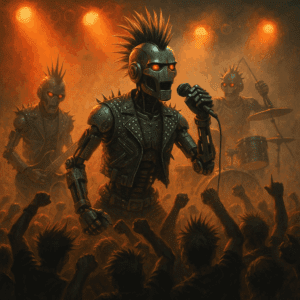
AI music is real. I mean to prove it.
I got to work on a project in a method I like to call Scatter Plotting. Mathematically, it’s when you have to draw a consistent average line through a series of disconnected points. What if I provided AI lyrics with no clear scheme or rhythm? What if, even in my reciting, I regularly changed patterns and added ambient noises and clicks?
What if I gave it madness and asked for method in return?
In the span of a weekend, I penned an EP full of romantically inappropriate songs about your mother with varying verses and rhyme schemes, packed with double entendres and overabundant sarcasm, then I made it available on Spotify, iTunes, and Bandcamp. What should’ve taken months, if not years, was done by breakfast on Monday.
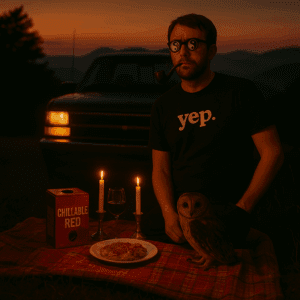
How’d it turn out? You tell me. Here are two examples of illustrious ballads about the woman who bore you:
View on BandCamp here…
But I wasn’t finished Scatter Plotting. While I loved the resulting tunes, what irked me was the 4/4 rhythm. Regardless of my vocal variance and my anti-rhythmic poetry, AI managed to snugly fit my incoherence into a typical scale. This called for further experimentation.
Having recently penned a novel and being in the process of seeking a literary agent at this moment, I decided to go personal. To write about myself as a writer and artist, then to satirize the process of seeking recognition in the modern world. But unlike before, I specified not just the words and the anti-rhythms buried therein, but I organized the very time structure of the songs.
How did it go?
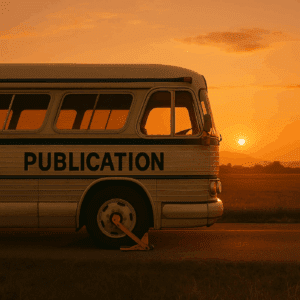
View album on BandCamp here…
It’s like Rick Beato said: AI music really allows more variance, providing a vehicle by which my words might traverse several genres within the span of a single album that I can create within a matter of hours. AI provides the ability to conceptualize and create without having to rattle out a diddy so many times that you learn to hate it before you get it right. By allowing me to traverse from idea to final product at such a speed, I listed the full album for two bucks without a second thought.
In short, AI music isn’t just real. It’s the embodiment of the democratization of music itself. It bids you explore, create, remix, remaster, and simply have fun. It invites each of us to become Impossible Burgerers in its kitchen, to whip up a dollop of I Can’t Believe It’s Not Music, and to enjoy it nonetheless.