

The Karen Read case became more than a criminal trial. It became a public argument, a media event, a social media battle, and a test of how difficult it has become to keep courtroom proceedings separate from the outside world.
That is what makes the case important beyond Massachusetts.
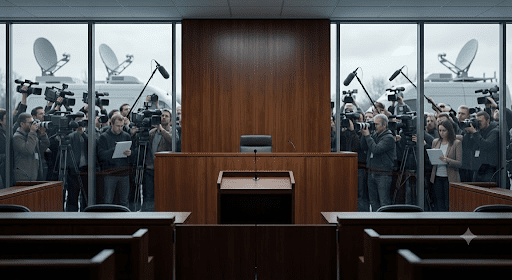
For anyone following high-profile litigation, the Read trial showed how quickly a criminal case can develop two parallel versions of reality. One version unfolds inside the courtroom, where evidence is introduced under rules, witnesses are questioned, objections are made, and jurors are instructed to consider only what they hear in court. The other version unfolds outside the courthouse, where commentators, supporters, critics, livestream viewers, influencers, and online communities build their own narratives.
Those narratives can harden long before a verdict.
Florida attorney David Di Pietro, who has appeared in national media discussing major legal matters, explains the challenge this way:
“High-profile trials face intense media scrutiny that can influence public perception long before a verdict, making it difficult for juries to remain insulated from external narratives.”
That is the central issue. A famous trial is not only judged after the verdict. It is judged every day online.
Why the Karen Read Case Became a Public Spectacle
The Karen Read case had the ingredients that often turn legal proceedings into national drama: a death, a law enforcement connection, disputed facts, allegations about the investigation, strong public emotion, and a defendant with vocal supporters.
Read was accused in the death of Boston police officer John O’Keefe. Her first trial ended in a mistrial. Her retrial then attracted intense attention before a jury ultimately found her not guilty of the most serious charges, while convicting her on a lesser impaired-driving offense.
But the courtroom result is only one part of why the case matters.
Long before the retrial ended, many people had already chosen a side. Some believed the prosecution’s theory. Others believed Read had been wrongly accused or that the investigation itself deserved scrutiny. Online, the case became a running debate over evidence, police conduct, witness credibility, expert testimony, and perceived inconsistencies.
For lawyers, that kind of environment creates a serious problem.
A jury is supposed to decide a case based on admissible evidence, not crowd opinion. But in a high-profile matter, the public narrative can become so loud that it surrounds the case before jurors are even selected.
The Courtroom Is Controlled. The Public Narrative Is Not.
Inside the courtroom, judges and lawyers operate within rules. Evidence has to be admitted. Witnesses can be cross-examined. Jurors receive instructions. Lawyers are limited in what they can say and how they can say it.
Outside the courtroom, very little works that way.
People can post theories, clips, edited commentary, emotional reactions, half-understood legal arguments, and selective facts. Some may be accurate. Some may be misleading. Some may be based on genuine concern. Some may be pure speculation.
The problem is not that the public has no right to care. Public scrutiny can expose flaws. Journalism can uncover important facts. Open courts are a vital part of the legal system.
The problem is that public attention does not follow the same safeguards as a trial.
A viral post does not require foundation. A livestream reaction does not need to meet the rules of evidence. A social media thread does not need to tell both sides. A documentary or commentary segment may be persuasive, but it is not a jury instruction.
That is why Di Pietro’s point about juries being insulated from external narratives matters. The more famous the case, the harder it becomes to maintain a clean boundary between what is legally presented and what is publicly believed.
Jury Selection Becomes Harder in Famous Cases
In an ordinary case, lawyers question potential jurors to determine whether they can be fair. In a high-profile case, that process becomes more complicated.
The question is no longer just whether a juror knows anything about the case. In many famous cases, almost everyone knows something. The better question is whether the juror has already formed an opinion, followed commentary, joined online discussions, consumed selective media coverage, or built emotional loyalty to one side.
Even when people honestly believe they can be fair, prior exposure can shape how they hear evidence.
A witness who seems credible to one person may seem suspicious to another because of something they read before trial. A piece of forensic evidence may be viewed through a theory already formed online. A cross-examination may be interpreted not as legal testing, but as confirmation of a public narrative.
That does not mean juries cannot be fair. It means the work of protecting the process becomes more demanding.
Judges may issue instructions. Lawyers may request careful screening. Courts may limit certain outside influences. But no court can fully erase what a person has already seen, heard, or absorbed.
High-Profile Trials Are Now Fought in Two Arenas
The Karen Read case also shows how modern litigation can become a two-arena fight.
The first arena is the courtroom. That is where the verdict happens.
The second arena is public perception. That is where reputations, media narratives, online campaigns, and long-term public memory are shaped.
For prosecutors, the challenge is to present a case that can withstand not only defense scrutiny, but also public skepticism. For defense lawyers, the challenge is to protect the client’s legal rights while also understanding that the outside narrative may influence how the case is perceived. For judges, the challenge is to preserve fairness without pretending the outside world does not exist.
This is not unique to the Karen Read matter. It is now part of the modern legal environment.
High-profile trials involving celebrities, police conduct, political figures, violent crime, corporate misconduct, or family tragedy can quickly become content ecosystems. Clips circulate. Legal analysts weigh in. Supporters organize. Critics respond. Every ruling becomes a signal to people already invested in the outcome.
That environment can help the public understand the justice system, but it can also distort the process.
The Danger of Deciding Too Early
One of the most important lessons from high-profile trials is that early certainty can be dangerous.
Trials are designed to unfold slowly for a reason. Opening statements are not evidence. A single witness does not tell the whole story. Expert testimony can be challenged. Investigative mistakes may matter, but their legal significance depends on context. A strong theory still has to survive the burden of proof.
Public commentary often skips those steps.
People hear one detail and decide. They see one clip and commit. They follow one commentator and adopt that frame. By the time the jury receives the case, the public may already be emotionally exhausted and divided into camps.
That is not how the legal system is supposed to work.
The courtroom process is imperfect, but it exists to slow people down. It forces claims through procedure. It gives both sides the opportunity to test evidence. It asks jurors to deliberate, not react.
In a media-heavy case, preserving that discipline becomes one of the hardest jobs in the room.
Why David Di Pietro’s Perspective Matters
David Di Pietro’s comment captures the deeper issue behind the Karen Read trial and other famous cases like it. The legal system is built around the idea that jurors can set aside outside influence and decide based on evidence. But the modern information environment makes that harder than ever.
This does not mean courts should operate in secrecy. It does not mean the public should stop paying attention. And it does not mean media scrutiny is always harmful.
It means that high-profile litigation requires a serious understanding of how public narratives form, how they spread, and how they can affect trust in the process.
For lawyers handling complex litigation, trial strategy, or public-facing legal disputes, the courtroom is no longer the only place where the case is being interpreted. The public may not decide the verdict, but it can shape the atmosphere around the case.
That is the real lesson of the Karen Read trial.
It was not only a criminal case watched by the public. It was a reminder that in modern high-profile trials, the battle over evidence and the battle over perception often happen at the same time.
Suggested reading:
David Di Pietro speaking to Fox News about Karen Reid retrial