


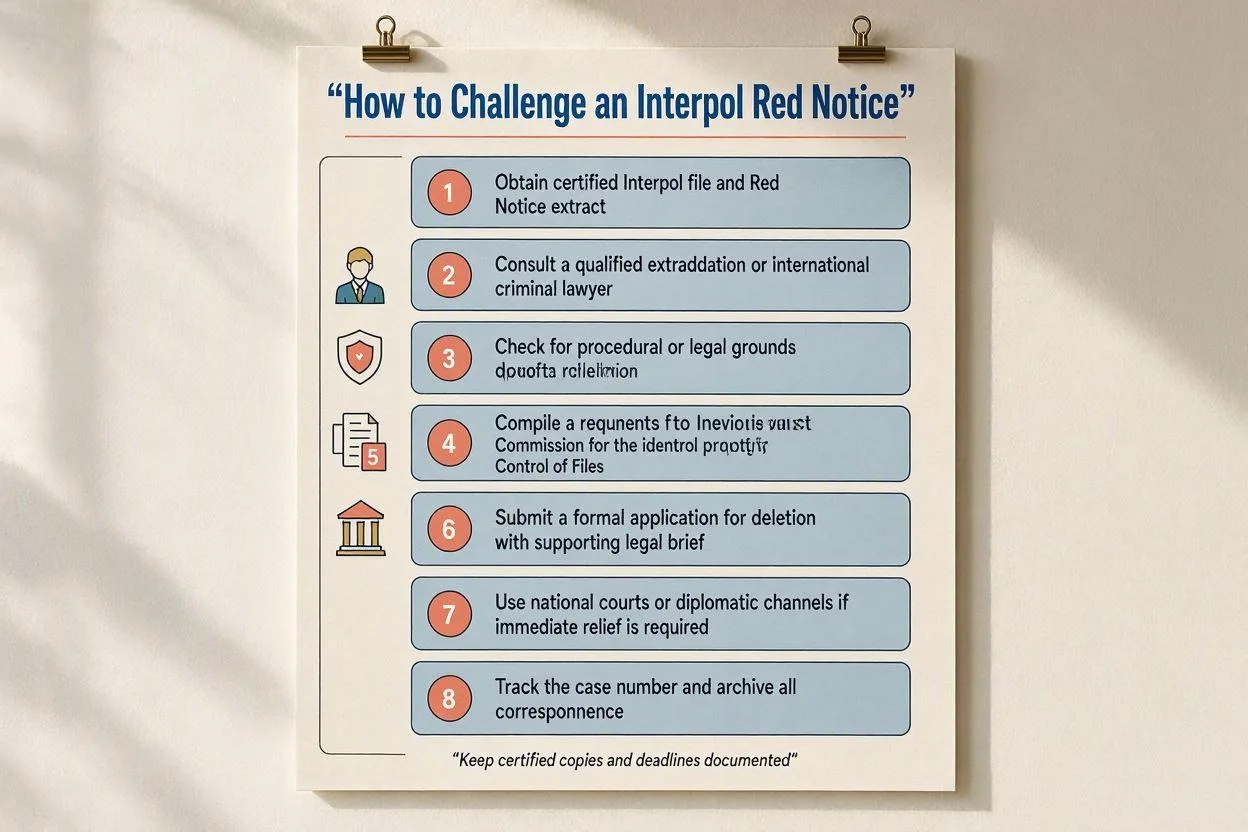
What affected people and families should know about confirming international police data, preserving evidence, preparing a Commission application, addressing urgent detention risks, coordinating parallel court proceedings, and verifying national database corrections after an INTERPOL Red Notice is restricted, corrected, withdrawn, or deleted.
WASHINGTON, DC, September 28, 2026 — Challenging an INTERPOL Red Notice requires more than writing a general denial, because the review process concerns whether international police data complies with INTERPOL’s Constitution and rules rather than whether a foreign criminal court should ultimately acquit the person.
The principal review body is the Commission for the Control of INTERPOL’s Files, commonly called the CCF, an independent institution that handles individual requests to access, correct, or delete personal data processed through INTERPOL’s information system.
A successful challenge can remove or correct international police circulation, but it does not automatically cancel the requesting country’s warrant, terminate a criminal prosecution, end an extradition case already supported through diplomatic channels, or clear every national database.
Affected people therefore need a carefully coordinated strategy that separates the INTERPOL data challenge from domestic arrest, immigration, asylum, extradition, reputation, and originating-country proceedings while ensuring important factual statements remain consistent across every legal forum.
This step-by-step public explainer from Amicus International describes the current review pathway, including the secure online submission system introduced in 2026, while emphasizing that procedures, deadlines, and legal arguments must be assessed individually.
Step One: Understand What the Challenge Can Accomplish
A Red Notice is a request for police worldwide to locate and provisionally arrest a person pending extradition, surrender, or comparable lawful action, based upon a national arrest warrant or equivalent judicial order supplied by the requesting jurisdiction.
The CCF reviews whether INTERPOL may lawfully continue processing that international data, considering rules governing human rights, neutrality, purpose, accuracy, relevance, proportionality, data quality, offense seriousness, and the requesting country’s intention to seek extradition.
The Commission is not the foreign trial court, does not decide every factual defense, cannot acquit the accused, and does not replace judges who decide bail, immigration status, extradition eligibility, or the validity of the national warrant.
The first strategic task is therefore to define the requested outcome precisely, whether access to unknown data, correction of identity or case details, deletion of noncompliant circulation, or revision of an earlier Commission decision based on genuinely new facts.
Step Two: Treat Arrest or Detention as a Separate Emergency
If the person has already been detained, the immediate priority is to obtain qualified local counsel, confirm the legal basis for custody, identify the next hearing, preserve interpretation rights, and calculate every provisional-arrest or extradition-document deadline.
A CCF application does not automatically suspend national detention, stop an extradition hearing, secure bail, or prevent immigration action, because the arresting country applies its own constitution, statutes, treaties, judicial orders, and procedural rules.
Local counsel should promptly coordinate with lawyers in the requesting country to verify the warrant, charges, evidentiary history, court decisions, and prosecutorial intentions, while ensuring submissions in different proceedings do not contradict one another.
Families should immediately record the arresting agency, detention location, officer details, case number, asserted legal authority, court schedule, possible transfer destination, medical needs, and consular information rather than assuming INTERPOL directly controls the person’s custody.
Step Three: Confirm What Is Actually Known
Many active Red Notices are not displayed on INTERPOL’s public website, meaning an unsuccessful online search alone does not establish that no notice, diffusion, message, or other relevant personal data exists within restricted law-enforcement channels.
Evidence may instead come from a border record, visa refusal, immigration document, banking inquiry, police disclosure, extradition file, public prosecutor’s statement, copied notice extract, court order, or official communication from a National Central Bureau.
The affected person should preserve complete copies, original electronic files, envelopes, metadata, certified translations, screenshots clearly showing dates, and detailed notes identifying who supplied each record because provenance and chronology can materially affect evidentiary value.
Rumors, unofficial database entries, anonymous messages, and social-media images should always be treated cautiously, since fraudulent notices, outdated screenshots, mistaken identity, and misleading commercial risk profiles can closely resemble authentic INTERPOL information circulated by authorities.
Step Four: Decide Between Access, Correction, and Deletion
An access request asks whether personal data is being processed and seeks whatever information may lawfully be disclosed, while a correction request targets inaccurate details and a deletion request argues that continued processing violates INTERPOL’s governing framework.
Applicants who know little about the alleged record may start with access, whereas someone with a public notice, arrest documents, or confirmed case information may combine access with correction or deletion arguments when strategically appropriate.
Waiting for complete disclosure can delay urgent protection, while filing a broad deletion request without understanding the allegations can create weak or misdirected arguments, so the right sequence depends on verified circumstances.
The United States Department of Justice guidance on contesting INTERPOL information confirms that people seeking disclosure or correction of data concerning themselves should direct their request to the CCF rather than treating INTERPOL Washington as the decision-maker.
Step Five: Identify Every Relevant Authority and Record
A formal challenge becomes substantially clearer when the applicant maps the requesting country’s police agency, prosecutor, court, National Central Bureau, warrant, case number, alleged offenses, procedural stage, conviction status, and stated intention concerning eventual extradition.
The same map should identify countries that granted asylum, refused extradition, dismissed domestic proceedings, recorded border stops, imposed immigration restrictions, or hold copied information that could continue to cause problems after INTERPOL deletion.
Applicants should obtain certified copies of favorable judgments, warrant withdrawals, acquittals, limitation rulings, refugee decisions, prosecutorial correspondence, and official identity documents rather than relying exclusively upon summaries written by lawyers or family members.
Where access to important records is impossible because proceedings are sealed, counsel is threatened, or authorities refuse disclosure, the application should explain those obstacles specifically and support them with reliable independent evidence whenever reasonably available.
Step Six: Build a Precise Chronology
A strong chronology should begin before the alleged offense and continue through investigation, political or commercial conflict, departure, warrant issuance, asylum activity, notice publication, border encounters, extradition requests, court decisions, and later communications from authorities.
Dates often reveal material compliance issues, including a warrant issued after political criticism, circulation maintained after dismissal, an extradition refusal omitted from the file, or prolonged inactivity despite the requesting country knowing the person’s location.
Each detailed chronological entry should identify the source document, responsible decision-maker, relevant jurisdiction, exact date, and legal significance, allowing reviewers to compare independently verified events against the narrative supplied by the requesting National Central Bureau.
The final chronology should remain factual, complete, and restrained because exaggerated claims, unsupported conclusions, irrelevant personal history, and inconsistent dates can distract from otherwise strong legal grounds while significantly damaging the applicant’s credibility.
Step Seven: Separate Identity Errors from Legal Objections
Mistaken identity arguments require an exact documented comparison of names, aliases, birth dates, citizenship, photographs, fingerprints, passport numbers, physical descriptors, addresses, and employment history, supported by authoritative civil and biometric records where legally obtainable.
A person may share a common name with the subject, encounter transliteration differences, or find that stolen travel documents were linked to the notice, making clear side-by-side evidence more persuasive than a general claim that police identified the wrong individual.
Legal objections address different questions, including whether the alleged offense qualifies for Red Notice circulation, whether the warrant remains valid, whether extradition will genuinely be pursued, or whether political and human-rights considerations make continued processing impermissible.
Presenting identity and legal objections under separate headings helps the Commission understand whether the applicant denies being the person described, challenges the lawfulness of processing, disputes particular facts, or relies upon several independent grounds.
Step Eight: Evaluate Article 2 and Human-Rights Concerns
Article 2 of INTERPOL’s Constitution requires international police cooperation within existing national laws and the spirit of the Universal Declaration of Human Rights, creating a framework for examining serious due-process, persecution, and treatment concerns.
Relevant evidence may include recognized refugee status, documented torture risk, fundamentally unfair proceedings, discriminatory prosecution, denial of essential defense rights, extreme punishment concerns, or credible judicial findings from countries that already considered extradition.
General criticism of the requesting country’s justice system is rarely as persuasive as reliable evidence directly connecting specific institutional problems to the individual applicant, prosecution, detention conditions, protected status, or likely treatment following surrender.
An extradition refusal based upon human-rights concerns can support the challenge, although it does not automatically require deletion because the Commission evaluates the decision’s reasoning, current circumstances, and relationship to INTERPOL’s own rules.
Step Nine: Evaluate Article 3 and Political Motivation
Article 3 strictly prohibits INTERPOL from undertaking interventions or activities possessing a political, military, religious, or racial character, requiring a careful case-specific assessment of whether prohibited features predominate over the alleged ordinary criminal conduct.
Useful evidence can include the applicant’s political role, public criticism, election activity, journalism, whistleblowing, religious identity, official threats, selective enforcement, suspicious timing, inconsistent accusations, reprisals against relatives, and statements revealing a coercive return campaign.
Because governments may frame political cases as corruption, fraud, terrorism, tax offenses, cybercrime, or misuse of office, the application should examine the underlying conduct rather than assuming an ordinary criminal label resolves the neutrality question.
The Commission’s predominance analysis considers the nature of the offense, the person’s status, the source of information, views expressed by other member countries, international obligations, neutrality implications, and the general context surrounding the case.
Step Ten: Examine Data-Quality and Purpose Requirements
Even without political or human-rights grounds, data may be challengeable when it is inaccurate, obsolete, irrelevant, disproportionate, insufficiently identifiable, connected to an invalid warrant, or retained without a legitimate continuing international police purpose.
Red Notices are intended for serious ordinary-law crimes rather than minor administrative violations, culturally controversial prohibitions, family matters, or private commercial disputes unless qualifying serious criminal activity clearly brings the particular case within applicable rules.
The requesting National Central Bureau should intend to seek extradition after arrest, making prolonged inaction potentially relevant when authorities know the person’s location but repeatedly fail to submit a lawful extradition request without reasonable explanation.
Applicants should also clearly identify acquittals, dismissals, limitation decisions, sentence completion, pardons, charge reductions, warrant cancellation, and corrected factual findings because every significant procedural development may affect the necessity or accuracy of continuing circulation.
Step Eleven: Document Refugee or Protected Status Carefully
Recognized refugee status may matter most when the notice comes from the country associated with the person’s established fear of persecution, because continued police cooperation could undermine international protection and non-refoulement obligations.
The applicant should provide the full official decision when available, identify the granting authority, show whether the status remains valid, and explain how the recognized persecution grounds connect to the country of origin and the underlying prosecution.
Asylum applications still pending, humanitarian visas, temporary protection, and informal political support do not necessarily carry the same legal effect as final refugee recognition, although they can remain relevant to the broader factual context.
International protection granted by one country also does not automatically resolve allegations originating from another unrelated jurisdiction, requiring careful individualized analysis of the source country, requested destination, offense, procedural history, and applicable refugee policy.
Step Twelve: Prepare an Admissible and Organized Submission
The application should identify the person precisely, explain the requested remedy, present numbered facts, state each legal ground separately, connect every important claim to an exhibit, and include readable certified translations where necessary.
Applicants or their duly authorized representatives must establish identity and authority to act, supply accurate current contact information, use the prescribed electronic submission method, and satisfy every applicable admissibility condition contained within the CCF’s operating rules.
The organized submission should include only materials meaningfully advancing the relevant issues, because hundreds of repetitive, untranslated, or unexplained pages can obscure decisive evidence and make an otherwise compelling application harder to evaluate efficiently.
A concise and carefully structured executive summary can identify the requested outcome, strongest compliance violations, current arrest risk, protected status, and essential procedural developments before the detailed chronology, legal analysis, supporting authorities, and indexed exhibits.
Step Thirteen: Use the Current Secure Online Portal
Since March 26, 2026, new CCF requests for access, correction, deletion, and revision generally must be submitted through INTERPOL’s dedicated secure online portal; email and postal submissions are no longer accepted except where the Commission recognizes exceptional circumstances.
The secure portal allows applicants or authorized representatives to submit materials, receive official communications, review exchanged documents, monitor case status, and obtain decisions, making careful account management and independent preservation of every confirmation especially important.
Applicants should follow the current portal guide, preserve submission receipts, maintain independent encrypted copies of exhibits, and respond through the official channel rather than trusting unsolicited messages or intermediaries claiming they can guarantee removal.
The CCF does not charge individual applicants a filing fee, although specialist legal representation, translations, certifications, expert evidence, and parallel court proceedings can create substantial private expenses that should be evaluated transparently and realistically in advance.
Step Fourteen: Manage Confidentiality Deliberately
CCF files are confidential, and an access or challenge request is not itself recorded as a police cooperation request, although the existence of a pending application may be indicated within the person’s file without disclosing its content.
The Commission may share necessary information with the General Secretariat and relevant National Central Bureaus while examining the case, meaning applicants should understand that effective review can require testing their allegations against the source country’s response.
An applicant can specifically identify particularly sensitive information as confidential, but withholding decisive evidence from the requesting bureau may materially limit the Commission’s ability to test the claim fully and could unintentionally weaken the application.
Document and report threats, coercion, surveillance, or reprisals connected to the filing through the portal, since the Commission considers such conduct even though it is not a human-rights court with direct enforcement powers.
Step Fifteen: Explain Urgency Without Expecting Automatic Suspension
When detention, imminent travel, extradition, family danger, or severe medical circumstances create urgency, the application should provide exact dates, supporting documents, court schedules, and a clear explanation of the irreversible harm that may occur.
INTERPOL’s internal compliance mechanisms can block data visibility when serious doubts arise, but filing a CCF request does not automatically deactivate the notice, halt independent national action, or guarantee expedited determination before a scheduled hearing.
Qualified local lawyers must therefore seek every available domestic remedy simultaneously, including bail, habeas review, urgent stay applications, immigration protection, judicial review, or substantive opposition to extradition, depending upon the arresting country’s applicable law.
Families should firmly resist advisers promising immediate deletion through secret contacts, because legitimate review follows established institutional procedures and no genuine representative can ethically guarantee the precise timing, reasoning, or outcome of an independent Commission decision.
Step Sixteen: Respond Promptly During the Review
After electronic submission, the CCF ordinarily acknowledges receipt, assesses formal admissibility, identifies the applicable review procedure, and may request clarification or additional evidence before placing the matter before the Requests Chamber for substantive consideration.
The Commission may consult the applicant and request information from the National Central Bureau, the General Secretariat, other entities, experts, and open sources, creating opportunities for new information that should be answered accurately, directly, and within any stated deadline.
Applicants should report material developments such as release, re-arrest, extradition refusal, warrant withdrawal, new charges, refugee recognition, intimidation, or corrected identity information rather than waiting for the Commission to discover those events independently.
Repeated unsolicited submissions with minor updates can create unnecessary confusion, so later communications should consolidate meaningful developments, clearly explain their legal relevance, and preserve a clean record of exactly what information the Commission received.
Step Seventeen: Understand the Published Decision Timelines
Under the CCF’s governing statute, access requests are intended to be decided within four months after becoming admissible, while correction or deletion requests are intended to receive decisions within nine months after admissibility.
Those published periods begin with formal admissibility rather than initial submission, and the Commission has publicly acknowledged workload-related delays, so affected families should prepare for uncertainty while meeting every domestic deadline and taking necessary protective measures.
The INTERPOL General Secretariat receives an opportunity to comment on correction or deletion conclusions, and final written notification can occur after the Commission’s substantive consideration rather than immediately when a scheduled review session formally ends.
Applicants should monitor official portal communications regularly, keep representative and personal contact details current, and avoid interpreting routine administrative silence as proof that the notice has disappeared, remained active, or received a particular substantive decision.
Step Eighteen: Interpret the Outcome Precisely
The CCF may conclude that data is compliant, direct correction, require deletion, limit disclosure, or address particular records differently, making the written reasoning and precise scope more important than informal descriptions such as “the case was cleared.”
When INTERPOL deleted Paul Watson’s Red Notice in 2025, the organization emphasized that removal did not decide the merits of Japan’s underlying allegations, demonstrating the distinction between data compliance and criminal adjudication described by The Associated Press.
A deletion decision means INTERPOL should remove the relevant international data and inform member countries, but the source country can potentially retain its national warrant and pursue lawful cooperation through channels outside INTERPOL.
A compliant data decision does not prove criminal guilt or guarantee eventual extradition, since national courts remain independently responsible for deciding arrest authority, evidentiary requirements, treaty defenses, refugee protection, human-rights objections, and final surrender eligibility.
Step Nineteen: Consider Revision Only with Genuine New Facts
The CCF does not provide an ordinary appeal that lets the applicant repeat rejected arguments, but its statute permits revision when a newly discovered fact probably would have produced a different conclusion if known earlier.
Revision applications must precisely identify the genuinely new fact, establish when and how it was discovered, explain its likely material effect, and generally be filed within six months after discovery through the secure online portal.
A later warrant cancellation, acquittal, extradition refusal, refugee decision, disclosed government document, or proven reprisal may qualify for analysis, while disagreement with the original reasoning alone ordinarily will not satisfy the revision standard.
The applicant should compare the new evidence directly with the earlier decision, demonstrating exactly which factual premise or compliance conclusion has materially changed rather than resubmitting the original case under a different title.
Step Twenty: Verify Implementation After Deletion
INTERPOL states that it removes deleted notices from its databases and that member countries receive regular notifications advising them to update national systems; a certificate confirming that the individual is no longer subject to the notice may also be available.
Effective implementation can still require extensive follow-up because police, immigration agencies, border authorities, courts, commercial databases, financial institutions, and media archives may hold independent or copied records created before the international deletion decision.
Counsel should identify every continuing restriction, determine its legal source, provide appropriate deletion confirmation, and request correction through the responsible national or private process rather than assuming one institutional decision automatically updates every system.
The person should securely preserve the final decision and confirmation, carry documents only when counsel considers that approach lawful and useful, and seek advice before international travel because the national warrant may remain active.
Common Mistakes That Weaken Challenges
Frequent mistakes include relying upon innocence alone, submitting unsupported political claims, omitting unfavorable facts, confusing INTERPOL with the extradition court, providing inconsistent dates, using uncertified translations, and failing to explain the requested remedy.
Other damaging errors include fabricated evidence, altered identity documents, false statements, abusive portal use, or unlawful evasion attempts, all of which can create additional criminal exposure while severely undermining an otherwise legitimate compliance challenge.
Applicants should not assume that hiring a prominent lawyer guarantees removal, since strong representation improves organization and issue identification but cannot replace evidence, governing rules, independent review, or unfavorable facts within the underlying record.
The strongest applications usually present a disciplined factual chronology, authoritative supporting exhibits, narrowly framed legal grounds, candid treatment of potential weaknesses, and a clear explanation that directly connects each claimed violation to INTERPOL’s actual data-processing standards.
What Families Should Prepare
Families can assist by collecting passports, birth records, photographs, fingerprint records when lawfully available, warrants, charging documents, judgments, asylum decisions, correspondence, border records, medical information, and verified evidence of political or personal threats.
They should maintain a carefully indexed secure archive, record every document source, obtain professional certified translations, preserve original metadata, and designate one responsible coordinator so lawyers across different countries receive consistent information rather than conflicting versions.
Realistic financial preparation also matters because detention, translation, foreign counsel, expert evidence, international travel, and document certification can become extremely expensive even though the CCF itself does not charge applicants an application fee.
The Amicus International Red Notice and extradition resource provides further public context concerning risk assessment, coordinated legal review, and lawful response planning when international police data affects borders, detention, immigration status, reputation, or personal security.
The Essential Public Takeaway
Challenging a Red Notice is a structured data-compliance proceeding requiring accurate identification, authoritative records, relevant legal grounds, careful portal filing, timely responses, and coordination with every national court or agency exercising independent power.
Removal can substantially reduce international police exposure, but it should be understood as one component of a broader strategy addressing the national warrant, extradition litigation, immigration consequences, copied databases, and ongoing reputational effects.
Families should act early, preserve evidence, avoid promises of guaranteed deletion, and maintain consistent lawful submissions because urgent improvisation after a border arrest is harder than organized preparation based on verified information.
This guide provides general public information, not legal advice, and anyone facing an actual notice, detention, border restriction, immigration action, or extradition case should obtain qualified counsel promptly because the correct procedure depends on current rules and individual facts.









Show Comments