


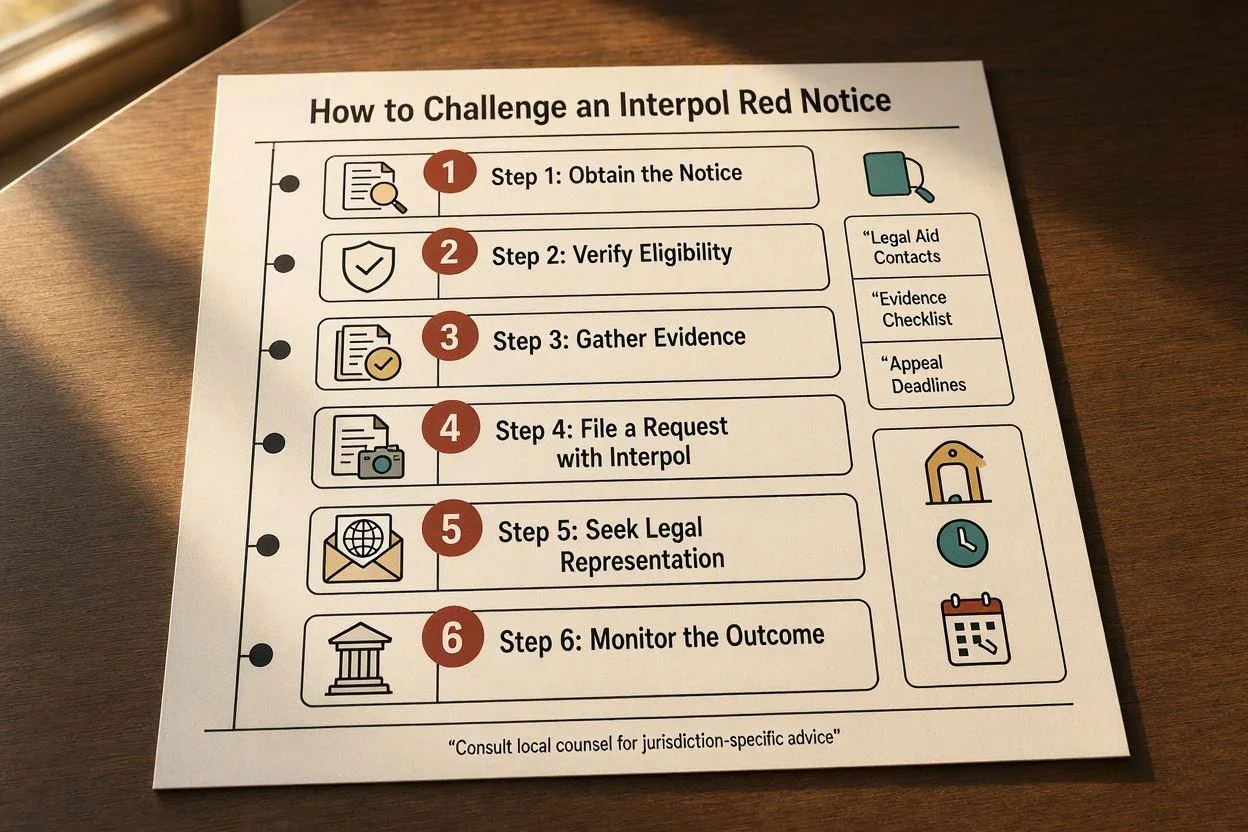
A clearer public explanation from Amicus International that distinguishes notice-based police coordination from court-backed warrants, while examining how requests, database alerts, domestic arrest powers, provisional detention, immigration measures, and extradition judgments are often compressed into inaccurate headlines.
WASHINGTON, DC, October 2, 2026 — News reports about internationally wanted people often move quickly from phrases such as “Red Notice requested” or “INTERPOL alert issued” to predictions of immediate arrest, worldwide detention, and inevitable extradition, although those expressions describe separate legal and operational stages.
The resulting confusion is understandable because a Red Notice can contribute to arrest at an airport, border crossing, hotel, residence, or police encounter, yet the notice itself remains a request for international cooperation rather than a court-issued warrant possessing universal legal force.
INTERPOL provides a secure framework through which authorities in 196 member countries share police information, but it does not operate a global criminal court, command national judges, send officers to seize suspects, or decide whether somebody will be extradited.
Every Red Notice begins with another authority’s criminal process, usually involving a national warrant or comparable judicial order, while every resulting detention depends on legal powers granted by the country where the person is found.
This public guide from Amicus International examines the most common misunderstandings appearing in news coverage and explains how readers can distinguish notice-based coordination, court-backed arrest authority, temporary detention, immigration enforcement, and final extradition decisions.
Misunderstanding One: INTERPOL Is the Government Seeking the Person
A familiar headline may say somebody is “wanted by INTERPOL,” but the individual is ordinarily wanted by a member country or qualifying international tribunal whose authorities issued the underlying warrant and requested international circulation.
INTERPOL does not charge the person, prosecute the alleged crime, produce the originating evidence, determine factual guilt, impose a criminal sentence, or serve as the requesting party in formal extradition proceedings between sovereign national governments.
Its General Secretariat reviews proposed notices for compliance, publishes qualifying information within the international system, and enables National Central Bureaus to exchange data, while the requesting jurisdiction retains responsibility for the criminal allegations.
Accurate reporting should therefore identify the country or tribunal seeking the person, distinguish allegations from established findings, and describe INTERPOL as the coordination channel rather than incorrectly presenting the organization as a supranational prosecutor.
Misunderstanding Two: A Government Request Means INTERPOL Has Issued the Notice
National police, prosecutors, courts, and political officials sometimes announce that they will request a Red Notice, but intent, domestic authorization, or completed submission does not mean INTERPOL has reviewed and published the requested alert.
The member country’s National Central Bureau must transmit appropriate identification and judicial information, after which INTERPOL’s specialized Notices and Diffusions Task Force examines the complete request against constitutional, data-quality, seriousness, neutrality, procedural, and human-rights requirements.
The task force may authorize publication, request clarification, restrict information, or reject the submission, meaning careful news coverage should distinguish among a proposed request, a submitted request, an approved notice, and a denied or withdrawn application.
The distinction becomes especially important in politically sensitive cases, where public officials may obtain publicity by announcing an international pursuit even though INTERPOL later concludes that the proposed circulation falls outside its governing rules.
Misunderstanding Three: A Red Notice Is an International Arrest Warrant
A Red Notice asks law-enforcement authorities worldwide to locate and provisionally arrest an identified person pending extradition, surrender, or comparable legal proceedings, but INTERPOL expressly states that this request is not an international arrest warrant.
A warrant is normally issued by a judge, court, prosecutor, or another authorized body under a particular legal system, whereas a Red Notice circulates information about an existing national warrant without transforming that instrument into universally enforceable authority.
The practical confusion arises because some countries permit provisional arrest after confirming a Red Notice, while others require a treaty request, prosecutorial approval, domestic judicial order, or separately established probable cause before detention can lawfully occur.
Reporting on Ghana’s former finance minister used more precise terminology, explaining that the notice alerted authorities to locate and potentially detain him while remaining legally distinct from an arrest warrant, as The Associated Press reported.
Misunderstanding Four: Every Country Must Make an Arrest
INTERPOL cannot compel member countries to arrest a notice subject because national sovereignty remains central, and every jurisdiction decides what legal significance the international information receives under its constitution, statutes, treaties, police procedures, and judicial precedents.
One country may authorize immediate provisional custody, another may require additional documents from the requesting government, and a third may record the alert without arresting because its domestic legal threshold has not been satisfied.
The United States Department of Justice guidance on Red Notice arrest authority explains that the United States does not consider a notice alone sufficient for arrest because it does not satisfy Fourth Amendment requirements governing domestic custody.
Consequently, reports stating that a person “can now be arrested anywhere” should be understood as descriptions of expanded international exposure rather than literal claims that identical arrest authority automatically exists throughout every member country.
Misunderstanding Five: INTERPOL Officers Conduct the Arrest
INTERPOL does not maintain a worldwide force of roaming officers empowered to cross national borders, enter homes, stop travelers, or place notice subjects in custody based upon instructions delivered from the General Secretariat in Lyon.
Authorities make any arrest under the law of the country where the encounter occurs, which may include national police, border officials, immigration officers, specialized fugitive units, or officers executing a domestic judicial order.
INTERPOL personnel and National Central Bureaus can facilitate communication, confirm data, coordinate identity checks, and support cooperation, but the arresting agency remains accountable to its own courts, procedures, constitutional limitations, and rules governing detention.
News accounts should identify the actual arresting authority and legal mechanism whenever possible, because phrases such as “INTERPOL arrested” obscure which government exercised coercive power and which court can review that decision.
Misunderstanding Six: The Public Website Contains Every Red Notice
INTERPOL publishes carefully selected notice extracts publicly when broader visibility could help locate a person, but many active notices remain available only through restricted police channels for operational, legal, investigative, privacy, security, or data-protection reasons.
An unsuccessful search of the public website therefore does not prove that no Red Notice exists, while a disappearing public page does not necessarily establish deletion because authorities may have changed visibility without canceling the underlying record.
Conversely, an image circulating through social media may be outdated, manipulated, or copied from an earlier listing, requiring confirmation from authoritative records rather than reliance upon screenshots, search-engine caches, or unofficial wanted-person databases.
Journalists should state whether they verified an active notice, located only a public extract, relied upon a government announcement, or received confirmation from counsel, because those sources do not carry identical evidentiary value.
Misunderstanding Seven: A Red Notice Proves Guilt
For people wanted for prosecution, the notice communicates an allegation supported by a national warrant or equivalent order, but it does not replace the criminal trial, determine evidentiary reliability, or overcome the presumption of innocence.
Other notice subjects may already be convicted and serving a sentence, so reporting must distinguish accused individuals from convicted individuals rather than using language that inaccurately places every case at the same procedural stage.
INTERPOL’s compliance review assesses whether international data processing satisfies institutional rules, but it does not hear witnesses, conduct a complete evidentiary trial, decide every defense, or certify the requesting country’s entire prosecution as factually correct.
Employers, banks, immigration authorities, and media organizations should therefore avoid treating publication as a final judgment, even while recognizing that the alert may constitute relevant risk information requiring lawful, proportionate, and independently reviewable action.
Misunderstanding Eight: A Border Match Automatically Confirms Identity
A passport scan or database alert can identify a possible match, but officers must still compare names, aliases, photographs, fingerprints, birth details, nationality, physical descriptors, document information, and other available identifiers before imposing prolonged custody.
Common names, transliteration differences, estimated birth dates, outdated photographs, stolen passports, and incorrect biographical entries can produce false matches, especially when information passes among jurisdictions using different languages, alphabets, formats, and record systems.
The local National Central Bureau may contact the requesting country to confirm that the notice remains active, the warrant is valid, extradition will be pursued, and the person encountered matches the international record.
News coverage during the first hours after detention should acknowledge that identity verification may still be underway, particularly when authorities release limited information and family members claim the wrong person has been stopped.
Misunderstanding Nine: A Red Notice Always Leads to a Criminal Arrest
International alert information can produce several legal responses beyond ordinary criminal arrest, including secondary border inspection, immigration detention, visa cancellation, passport restriction, surveillance, questioning, reporting conditions, administrative removal, or a request for additional judicial documents.
Those mechanisms should not be treated as interchangeable because criminal arrest, provisional extradition custody, immigration detention, deportation, expulsion, and voluntary departure arise from different legal powers and provide different rights, deadlines, and review procedures.
A government may use immigration law when extradition requirements are unavailable, although courts may scrutinize whether removal procedures unlawfully circumvent treaty protections, refugee obligations, due-process guarantees, or restrictions against return to persecution and torture.
Careful and accurate reporting should describe what authorities actually did rather than assuming that every detention represents execution of the foreign warrant, formal commencement of extradition, or a final enforceable decision to send the individual away.
Misunderstanding Ten: Provisional Arrest Means Extradition Has Been Approved
Provisional arrest is an urgent temporary measure designed to prevent departure while the requesting state prepares and delivers its formal extradition request, supporting documents, authenticated warrants, evidentiary materials, legal provisions, and certified translations.
The applicable treaty or statute usually sets a deadline, and failure to provide an adequate package within that period can result in release even if the original national warrant and any future extradition efforts remain unresolved.
After documents arrive, the requested country may examine identity, treaty coverage, dual criminality, evidentiary sufficiency, limitation periods, political-offense restrictions, nationality protections, prior adjudication, prison conditions, fair-trial guarantees, and potential exposure to prohibited punishment.
An arrest can therefore be lawful at the provisional stage while extradition is later denied, just as release from provisional custody can result from missed deadlines without representing a judicial declaration of innocence.
Misunderstanding Eleven: The Extradition Court Conducts the Foreign Trial
A formal extradition hearing generally determines whether applicable legal requirements permit surrender, rather than deciding ultimate criminal guilt through the full evidentiary trial process that would ordinarily occur in the requesting country after extradition.
The requested country’s court may assess an evidentiary threshold established by treaty or statute, but it ordinarily does not resolve every factual conflict, hear the entire defense case, or substitute itself for the foreign trial court.
This limited role does not make extradition automatic because courts can still consider mandatory and discretionary objections involving political purpose, protected status, procedural deficiencies, human-rights dangers, punishment, double jeopardy, limitation periods, or insufficient supporting material.
News reports should therefore avoid saying an extradition judge “found the person guilty” when the actual ruling merely certified legal eligibility for surrender or rejected a particular barrier raised by the defense.
Misunderstanding Twelve: Release Means the Notice Was Invalid
A court or agency may release a person because identification failed, local arrest authority was insufficient, documents arrived late, bail was granted, extradition was refused, immigration powers expired, or diplomatic assurances remained inadequate.
None of those outcomes necessarily establishes that INTERPOL violated its rules when authorizing the notice, because a compliant international alert can encounter independent barriers created by national law, treaty interpretation, constitutional protection, or later factual developments.
Similarly, a requested country may refuse extradition while recognizing that the requesting jurisdiction’s underlying national warrant remains valid within its own territory, potentially leaving the person exposed to renewed legal proceedings if international travel occurs elsewhere.
Responsible coverage should report the precise reason for release and distinguish temporary liberty, bail, dismissal, extradition refusal, notice deletion, and cancellation of the underlying warrant rather than treating every favorable outcome as identical.
Misunderstanding Thirteen: Notice Deletion Erases the National Case
When INTERPOL deletes a Red Notice, the organization removes the international record from its systems and informs member countries, but the requesting government may continue maintaining its domestic warrant, charges, conviction, or investigation.
Deletion may follow Article 2 or Article 3 concerns, inaccurate data, an expired warrant, refugee protection, insufficient seriousness, lack of extradition intent, voluntary withdrawal, or another compliance issue, each with different implications for the underlying case.
National agencies may also retain independent records created through domestic law, bilateral cooperation, immigration proceedings, or earlier investigative action, making database correction a multi-institutional process rather than an automatic consequence of deletion in Lyon.
The reverse can also occur when a national warrant is withdrawn, but the requesting authority fails to update international partners promptly, producing stale information that continues disrupting travel until INTERPOL and relevant countries correct their records.
Misunderstanding Fourteen: Asylum Automatically Cancels Every Alert
Recognized refugee status can create powerful protection when a notice originates from the country of feared persecution, and INTERPOL maintains a refugee policy addressing circumstances in which continued cooperation would conflict with international protection principles.
However, asylum formally granted by one country does not automatically erase every outstanding national warrant, prohibit all third-country police action, or conclusively resolve allegations originating from another jurisdiction unrelated to the recognized persecution claim.
Responsible authorities must carefully examine the granting country, source country, protected grounds, alleged offense, current status, proposed extradition destination, non-refoulement duties, and any available evidence suggesting that criminal charges represent a disguised continuation of persecution.
Responsible news coverage should therefore avoid both misleading extremes, neither implying that refugee recognition is irrelevant nor reporting that asylum provides universal immunity from every criminal allegation, border decision, police encounter, or international judicial request.
Misunderstanding Fifteen: No Extradition Treaty Means No Risk
The absence of a bilateral extradition treaty may prevent or complicate formal surrender, but it does not necessarily eliminate arrest, immigration detention, deportation, expulsion, regional cooperation, domestic prosecution, or transfer under another applicable legal arrangement.
Some countries can lawfully extradite through domestic legislation, multilateral conventions, reciprocity, regional arrangements, or case-specific authority, while others strictly require a bilateral treaty and may refuse surrender despite maintaining temporary custody during judicial review.
Nationality rules, diplomatic relations, regional agreements, offense-specific conventions, domestic statutes, and binding human-rights obligations can materially alter the result, making simplistic online lists of “non-extradition countries” unreliable for serious public analysis or personal decision-making.
The existence of a treaty is therefore an important starting point rather than a complete prediction, because actual outcomes depend upon the offense, evidence, requested person, procedural history, arresting country, and every applicable legal safeguard.
Misunderstanding Sixteen: Banks and Employers Must Treat the Person as Convicted
A Red Notice may trigger enhanced compliance review, particularly when allegations involve financial crime, corruption, sanctions, organized crime, or identity concerns, but private institutions remain responsible for applying relevant law and fair internal procedures.
Automatic account closure, employment termination, or public accusation may create disproportionate harm when the organization fails to verify notice status, distinguish allegations from convictions, check for mistaken identity, or provide an effective correction mechanism.
Financial and professional institutions should identify the specific legal obligation actually involved, document their proportional risk assessment, protect confidential personal information, and promptly reconsider restrictions when INTERPOL, courts, or requesting authorities update the underlying record.
Journalists should also avoid repeating commercial database entries as independently verified facts because third-party platforms can preserve outdated extracts, combine different people, omit important deletion decisions, or materially mischaracterize a case’s procedural status.
How Readers Can Decode Red Notice Headlines
The first essential question should ask who issued the underlying warrant, while the second should determine whether authorities merely announced an intention, formally submitted a completed request, or received confirmation that INTERPOL actually authorized publication.
The third question should identify whether the notice is publicly visible or confirmed through an authoritative source, and the fourth should examine what legal power the country of encounter used to question, restrict, or detain the person.
Readers should then distinguish provisional arrest from final extradition, verify whether supporting documents arrived, identify the court’s actual ruling, and determine whether later release involved bail, procedural failure, human-rights concerns, or notice deletion.
Published reports should consistently state whether the person is accused, convicted, detained, released, extradition-eligible, formally surrendered, administratively deported, or still challenging the underlying data, because those descriptions identify materially different positions within the international process.
What Journalists Should Verify Before Publication
Before reporting that a Red Notice exists, journalists should confirm it through INTERPOL’s public database, the relevant National Central Bureau, court documents, official statements, or counsel, while explaining when independent confirmation remains unavailable.
They should avoid publishing unnecessary passport numbers, family details, addresses, or biometric information copied from wanted records, since legitimate reporting can explain the public-interest case without increasing identity theft, harassment, or personal-security risks.
Balanced news stories should include the requesting authority’s specific allegations and the subject’s response when available, while carefully preserving the distinction between a government statement, judicial finding, INTERPOL compliance decision, and independently verified factual evidence.
Headlines become more accurate when they use phrases such as “country requests Red Notice,” “INTERPOL publishes alert,” “local court issues arrest order,” or “extradition approved,” rather than collapsing every development into “international warrant issued.”
What Families Should Understand After Detention
Families should identify the arresting agency, detention location, asserted legal power, case number, hearing date, transfer destination, and document deadline before assuming that INTERPOL controls custody or that extradition has already been approved.
Qualified extradition counsel in the arresting country should coordinate closely with lawyers in the requesting country to verify the warrant, notice status, allegations, applicable treaty, procedural history, identity evidence, and any documented refugee or human-rights concerns.
Public statements should remain measured and factually consistent because inaccurate claims can complicate bail, immigration, Commission, criminal, and extradition proceedings, while unnecessary disclosure can endanger vulnerable relatives or create permanent online records from incomplete early information.
The Amicus International Red Notice and extradition resource offers additional public context concerning notice verification, treaty analysis, international coordination, and lawful response planning when police alerts affect detention, borders, immigration status, reputation, or personal security.
The Clearer Explanation
A court-backed national warrant provides the originating legal accusation, INTERPOL notice-based coordination shares identifying and judicial information internationally, and the country locating the person decides whether its laws authorize arrest or another restriction.
Provisional detention buys time for formal extradition documents, an extradition court to evaluate whether surrender is legally permitted, and an executive authority to make a later decision depending on the structure of the requested country’s system.
These stages can follow one another quickly, but they remain legally distinct, which explains why a notice may lead to immediate detention in one country, no arrest in another, and eventual extradition refusal elsewhere.
Clear public language protects both justice and individual rights because accurate reporting helps police alerts retain credibility, prevents allegations from becoming premature convictions, and enables readers to understand who exercised authority at every stage.
This guide provides general public information, not legal advice, and anyone affected by an INTERPOL notice, border restriction, detention, immigration action, or extradition request should promptly seek qualified counsel because legal powers, deadlines, and remedies differ significantly by jurisdiction.








Show Comments