


Construction and demolition debris is one of the quieter success stories in American waste management, at least on paper. The category is enormous. The Environmental Protection Agency put it at 600 million tons in 2018, which is more than twice everything American households throw away in a year. And a large share of it gets diverted rather than buried.
That headline is true, and it is also the reason a homeowner replacing a roof tends to assume the debris in the driveway is headed somewhere useful.
For most of that 600 million tons, it is. For the specific material coming off a roof, it generally is not.
Concrete is carrying the average
The reason the aggregate number looks so good is that concrete dominates the tonnage, and concrete is genuinely easy to recycle. Crushed and screened, it becomes road base and fill. Reclaimed asphalt pavement follows a similar path back into new asphalt mixtures. Those two materials are heavy, they are produced in enormous volume, and they have established markets.
Weight-based recycling rates reward exactly that kind of material. When one input is both the heaviest and the most recyclable thing in the stream, it pulls the whole average up and hides what is happening to everything else.
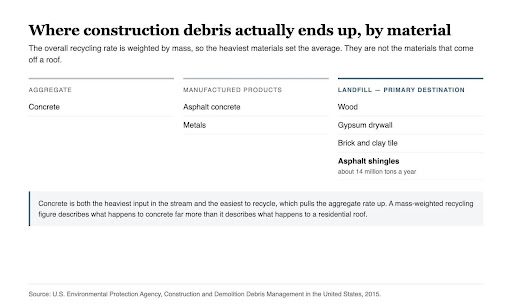
The EPA’s own accounting is blunt about where the rest goes. In its report on construction and demolition debris management, the agency states that landfills were the primary destination for wood, gypsum drywall, brick and clay tile, and asphalt shingles.
Roofing debris sits in that second list.
The shingle number
Asphalt shingles are not a rounding error. The EPA put them at roughly 14 million tons in a single year, and the great majority of that tonnage went into the ground rather than into anything else.
This is not because shingles are impossible to recycle. They are made largely of asphalt, and ground-up shingles can be fed back into asphalt pavement mixtures. The technology exists and some states run real programs around it.
The obstacles are practical rather than technical. Tear-off shingles arrive mixed with nails, felt, flashing, and whatever else came off the roof, and separating that is labor. Older material can contain asbestos, which changes the handling requirements entirely. Processing capacity is regional, so a given load may have somewhere to go or may not, depending entirely on the market within trucking distance.
The result is a material that is technically recyclable and, in most places on most jobs, still landfilled.
Why this shows up on the invoice
Here is where a national waste statistic turns into a line item on a residential roofing job.
Because shingles mostly go to a landfill, and because landfills bill by weight, roofing debris is priced by the ton rather than by the truckload. That single fact drives most of the surprises homeowners encounter at the end of a roof replacement.
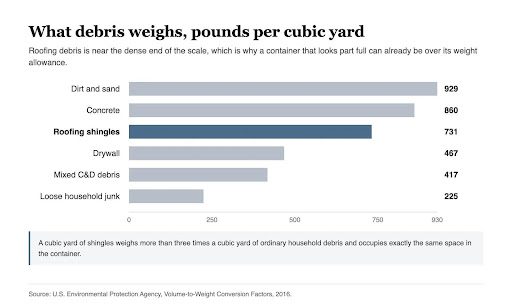
Shingles are also dense. Under the EPA’s published volume-to-weight conversion factors, roofing debris runs about 731 pounds per cubic yard, well above mixed construction debris at 417 and loose household junk at 225. A container that looks a third full of shingles can be carrying more weight than the same container packed to the top with furniture and cardboard.
The consequence is that container volume is the wrong thing to plan around. A roof is a weight problem wearing a volume problem’s clothing, and the conversion from roof area to tonnage is the step that actually determines the bill. That conversion is not intuitive, which is why it is worth reading a breakdown of how roofing squares translate into dumpster tonnage before booking anything.
The second layer problem
There is one variable that moves this arithmetic more than any other, and it is frequently unknown when the job is quoted.
Plenty of houses are carrying two layers of shingles, because a previous owner paid for an overlay rather than a full tear-off. Nobody establishes this with certainty until the crew is on the roof and the first layer comes up.
When it happens, the debris estimate the entire job was priced around is off by roughly a factor of two. The container that was adequate is not, and the overage is calculated against a weight allowance that was set for a single-layer job.
An experienced roofer will raise the possibility in advance. A homeowner hiring on price alone often does not hear about it until it is discovered.
What actually reduces the bill
Given that the material is probably going to a landfill and is definitely going to be weighed, the levers available to a property owner are narrower than they look.
Keeping the load clean is the main one. A roofing container that also collects old carpet, yard waste, a couple of appliances, and construction scrap from an unrelated project is heavier than it needed to be, and it may also pick up handling problems. Materials that require separate disposal have a way of arriving in a roofing dumpster because it happens to be the container sitting in the driveway that week, and the list of what cannot go in a roll-off is longer than most people expect.
Sizing to weight rather than volume is the other. Included tonnage generally scales with container size, and it does not scale gently, so the larger container is occasionally the cheaper booking on a heavy job even where the headline rate is higher.
Asking about recycling is worth doing, with realistic expectations. In regions with shingle processing capacity it is a genuine option. In many places it is not, and a hauler who says so plainly is being more useful than one who implies otherwise.
The honest version of the statistic
None of this is an argument that construction recycling is a fiction. Six hundred million tons is a real number, and the concrete and asphalt pavement being diverted from landfills is a real environmental gain.
It is an argument for reading the aggregate carefully. A recycling rate weighted by mass tells you what is happening to the heaviest material in the stream. It does not tell you what is happening to the material on your particular roof, and for asphalt shingles the honest answer is that it is probably being buried and definitely being weighed.
Plan the job around that, and the number at the end stops being a surprise.
By Clint L. Sanchez