


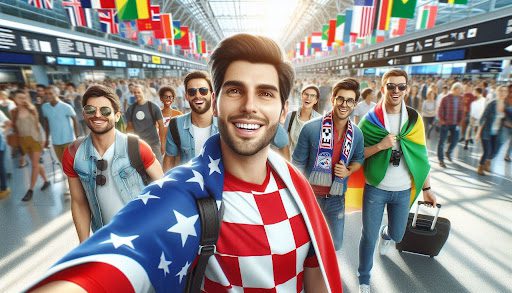
The tournament is expected to fill stadiums across America next summer, but tougher visa rules, interview backlogs, security screening, and country-based restrictions are likely to change which international supporters actually make it through the gates.
WASHINGTON, DC
The 2026 FIFA World Cup was supposed to be the biggest and most globally accessible tournament in football history, but for many international supporters planning to attend matches in the United States, the true qualification round may begin at a consular window rather than on the pitch.
With the tournament opening on June 11 and running through July 19 across North America, and with most of the 104 matches taking place in the United States, the question is no longer whether fans want to come, but whether enough of them can clear immigration in time to attend.
The biggest divide will be between easy-entry fans and everyone else.
For supporters from countries eligible for the Visa Waiver Program, or for travelers who already hold valid U.S. visitor visas, the road to kickoff is still relatively straightforward, which means many European, wealthier Asian, and already document-ready travelers remain well positioned to fill much of the foreign attendance base.
For everyone else, especially fans who need a first-time B1 or B2 visitor visa interview, live in countries with long queues, or fall under newer screening rules, the United States portion of the tournament is becoming much harder to treat as a spontaneous sports trip.
The gap matters because World Cup attendance is driven not only by purchasing power but also by time, mobility, and the administrative capacity to travel on short notice as tickets, fixtures, and accommodation windows shift rapidly in the final weeks.
That means the visa policy does not merely decide who can legally enter, but also who can realistically plan, pay, and commit, which is why the crowd inside U.S. stadiums may look more filtered by paperwork than most past World Cups.
Priority lanes will help, but they will not erase the structural backlog.
Washington has already acknowledged the pressure by promising faster access for some ticket holders, and in a Reuters report on the United States plan to prioritize World Cup visa appointments, officials said a special scheduling system would move confirmed fans more quickly through the interview line.
That initiative matters, and it may save thousands of trips, but it does not repeal geography, because faster lanes only help once a supporter has a ticket, a complete application, a consular post operating normally, and a legal route that still permits visa issuance.
The same Reuters report said the State Department had added 400 consular officers and expected the World Cup to bring millions of visitors, which shows that Washington understands the scale of demand even while insisting that vetting standards will remain firm.
Still, a priority system works best where capacity already exists, and it works much less dramatically where staffing is thin, applicants are concentrated, or entire nationalities face extra conditions that have little to do with football and everything to do with broader immigration policy.
The current appointment map shows why fan travel will be uneven rather than uniformly blocked.
According to the State Department’s current visa guidance and global wait-time tracker, some posts remain relatively manageable, while others still force would-be visitors into timelines that feel out of sync with the compressed rhythms of a summer sporting event.
As of the most recent update, London was showing roughly a two-month next available B1 or B2 appointment, Mexico City about one and a half months, and Sao Paulo roughly one month, all of which are inconvenient but still workable for fans planning early enough.
The picture becomes far harsher in other markets, because Bogota was showing about nine months, Mumbai around seven and a half months, New Delhi around seven months, Monrovia around ten and a half months, Santo Domingo around thirteen months, and Dubai about twelve and a half months.
Those numbers do not mean every applicant will wait exactly that long, because embassies do release additional slots, but they do mean the tournament’s practical accessibility changes dramatically depending on where a supporter lives and where that supporter must interview.
The new residency rule makes cross-border workarounds harder for ordinary fans.
Since December 2025, the United States has instructed most non-immigrant visa applicants to apply in their country of nationality or residence, which reduces the old habit of shopping for a faster third-country appointment when a local post looked jammed.
That matters directly for World Cup travel, because fans who might once have tried to hop to a neighboring country for a quicker interview now face a system that is more suspicious of location shopping and more explicit about residence requirements.
The practical result is that supporters in countries with long waits are less able to engineer a workaround, which means appointment scarcity in one place is more likely to remain a barrier instead of being solved through clever planning and a cheap regional flight.
For football supporters following a team across the United States, Canada, and Mexico, that loss of flexibility is especially significant, because the tournament’s three-country structure encourages movement while the visa system is increasingly trying to pin applicants to home-based consular channels.
For some supporters, the problem is not delay but outright exclusion from visitor visa issuance.
Under current U.S. rules, the administration fully suspended visa issuance for nationals of 19 countries and partially suspended it for nationals of 19 more, with major sporting event participants carved out, but ordinary fans still outside that comfort zone.
That means athletes, coaches, and necessary support staff may still travel under exceptions, but large numbers of ordinary supporters from affected countries can submit applications and attend interviews only to discover that issuance is still barred or heavily constrained.
The effect on World Cup attendance could be especially visible for football-heavy markets that reliably produce traveling fans, diaspora excitement, and television-scale national enthusiasm, because some of those countries now face legal barriers far beyond ordinary backlog.
Even where a narrow national-interest exception remains technically possible, it is not a mass-fan policy, which means the away end for certain national teams or football cultures could be thinner, quieter, and more diaspora-dependent than organizers once imagined.
Visa bonds add another layer of cost to what was already becoming an expensive trip.
In March, the State Department identified dozens of nationalities now subject to visa bonds, meaning applicants who are otherwise found eligible for B1 or B2 visas may still be required to post $5,000, $10,000, or $15,000 before traveling.
For a family or a small supporter group already paying for flights, accommodation, match tickets, local transportation, and time away from work, that requirement immediately changes the economics of attendance, especially in countries where supporter travel is fueled more by sacrifice than by surplus wealth.
A World Cup trip was always a premium purchase, but a tournament that requires some fans to post a five-figure bond before boarding a flight is no longer simply expensive; it becomes structurally tilted toward wealthy travelers and corporate guests.
That does not mean the stadiums will be empty, but it does mean the mix of international visitors may skew more affluent, more established, and more document-ready than the global football audience the event likes to imagine welcoming equally.
Enhanced screening is also changing the psychology of attendance.
The United States expanded online presence screening this spring for additional visa categories, and while the most direct burden still falls on applicants outside the standard tourist stream, the broader policy message is unmistakable: the immigration system is leaning toward more review, not less.
At the same time, interview waivers were narrowed last year so that most non-immigrant applicants generally require an in-person interview unless they fall into a relatively limited set of exceptions, including certain diplomatic travelers and some recent B-visa renewals.
For ordinary supporters, that means more interviews, more screening, more uncertainty, and a greater chance that the trip becomes psychologically exhausting even before airfare is booked, especially for first-time U.S. travelers who expected football to simplify entry rather than complicate it.
This is also why modern border technology matters more than many casual travelers realize, because machine-readable and electronic passports, as explained in Amicus International Consulting’s overview of electronic passports and its review of the high-tech features that make passports secure, allow officers to examine identity, travel history, and document consistency much faster than older paper-era systems ever did.
The fans least affected are those who already appear administratively safe.
Supporters of the Visa Waiver Program can usually travel for short stays with ESTA approval instead of pursuing a full visitor visa, while Canadian citizens generally do not need a non-immigrant visa for ordinary tourism, which creates an enormous practical advantage before the first whistle is blown.
Fans who already hold valid U.S. visas also remain in a stronger position because the State Department has said that visas issued before January 1, 2026, were not revoked under the current proclamation and remain valid for travel if otherwise valid.
That means two people with equal passion for the same match may face completely different realities, because one may need only a plane ticket and hotel reservation while the other must confront an interview, a bond, additional scrutiny, and the possibility of legal ineligibility.
In a tournament built around global inclusion and mass fan culture, that administrative inequality will likely shape not only who arrives, but how those arrivals feel about the United States as a host country when they compare access across all three co-host nations.
The consequence may be smaller away contingents and larger diaspora crowds.
The United States will still attract large foreign audiences, and the biggest matches will still sell aggressively, but the composition of those crowds may shift toward fans already living in North America, travelers from easy-entry countries, and neutral visitors able to absorb higher costs and tighter timelines.
That could matter deeply for the atmosphere, because a true traveling supporter base changes the sound, color, and emotional geometry of a World Cup stadium in ways that cannot be perfectly replicated by diaspora enthusiasm, hospitality buyers, or domestic neutrals filling extra seats.
For some national teams, especially those with fan bases concentrated in countries facing visa friction, the U.S. matches may feel less like a global invasion and more like a diaspora reunion, which is still powerful but not identical.
For FIFA, host cities, and broadcasters, the optics will still be excellent because capacity crowds matter most on camera, yet on the ground, the cultural texture of certain fixtures may feel more shaped by immigration law than by sporting demand.
Mexico and Canada may absorb some of the fan energy that the United States cannot.
Because the tournament is spread across three countries, some supporters who cannot easily enter the United States may still decide to attend matches in Mexico or Canada, follow fan zones there, or plan travel around parts of the bracket that remain outside U.S. territory.
That could create an unintended redistribution effect in which the United States retains the largest revenue base and the most matches, but loses some of its most organic international supporter traffic to neighboring hosts with different entry systems or fewer policy shocks around visitor screening.
The complexity becomes sharper for fans whose teams move across borders during the tournament, because a supporter who can lawfully reach Mexico or Canada may still be blocked from seeing the next match if the knockout path crosses into the United States.
In practical terms, that makes the North American World Cup feel less like one seamless festival for some travelers and more like three overlapping immigration regimes stitched together by football, airfare, and a great deal of advance paperwork.
The economic effect will probably be visible long before the final.
Host cities in the United States are still likely to do strong business, especially because demand from domestic travelers, corporate buyers, and easier-entry foreign visitors remains high, but cities that expected especially broad international spillover may see the impact in booking patterns and stay lengths.
Fans who worry they cannot secure a visa in time are more likely to avoid nonrefundable hotel commitments, delay long-haul purchases, or opt for single-city trips rather than extended multi-match itineraries that would otherwise spread spending across restaurants, transport, retail, and tourism.
The economic risk is not that the World Cup suddenly fails, because that seems highly unlikely, but that the tournament becomes more segmented, with the most fluid money and movement coming from a narrower slice of the global fan market.
That matters because the best World Cups not only sell seats but also create a month-long, circulating economy of supporters moving between cities, and visa friction works against exactly that kind of spontaneous, rolling, cross-country travel behavior.
FIFA’s warning about tickets and entry has turned out to be more than routine legal language.
Football’s governing body has repeatedly warned that a match ticket does not guarantee admission to a host country, and in a normal tournament cycle, that line can sound like standard fine print attached to any major international event.
In the 2026 U.S. context, however, that warning has become a central travel fact because a supporter can legally buy a seat, arrange a hotel, and still remain blocked by a visa queue, a suspension category, a bond requirement, or a missed interview slot.
That disconnect is likely to produce one of the stranger dynamics of this World Cup, where demand for matches may remain extraordinarily high on paper, even as a meaningful slice of the foreign audience still cannot convert desire into physical attendance.
For supporters who grew up thinking the World Cup was the most democratic sporting pilgrimage in the world, the lesson is becoming soberingly bureaucratic, because the stadium may be open, the ticket may be real, and the border may still say no.
The tournament will still be huge, but it may not feel equally open to the world.
None of this means the United States will fail as a host, because the country still has vast internal demand, enormous diaspora populations, and enough returning travelers and visa-waiver visitors to keep matches packed and television images spectacular.
What it does mean is that the 2026 World Cup in the United States is increasingly likely to reveal a two-speed version of global fandom, where the administratively mobile move quickly and the rest discover that football passion does not outrun immigration policy.
That is the real attendance story taking shape now, because the impact of visa restrictions will probably be felt less in empty seats than in who occupies them, how they got there, and which fan cultures never made it to the turnstiles.
If that pattern holds through the summer, the biggest tournament in football history will still make noise across America, but some of the voices missing from that noise will have been filtered out long before kickoff by the quiet power of consular rules.