


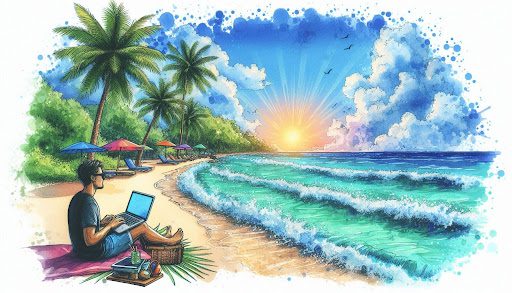
While beachside offices and complete geographical freedom offer unmatched personal growth, a growing number of digital nomads face burnout, isolation, and the hidden logistical exhaustion of a rootless existence.
WASHINGTON, DC, the digital nomad dream was sold as the final liberation of modern work, but for many remote professionals, the fantasy of laptops by the sea has given way to a quieter desire for routine, stability, deeper friendships, and a home that does not disappear every thirty days.
The freedom movement is meeting its emotional limit.
For more than a decade, digital nomad culture promised an escape from fluorescent offices, expensive cities, rigid schedules, and the emotional weight of building a life around one employer, one lease, and one commute.
The image was powerful because it offered workers a seductive trade, replacing cubicles with cafés in Lisbon, conference rooms with beachside coworking spaces in Bali, and office politics with the apparent freedom to choose any skyline.
Yet the reality beneath that dream has become harder to ignore, especially as more remote workers describe exhaustion from visas, time zones, housing searches, taxes, health care gaps, unreliable internet, shallow friendships, and the endless work of starting over.
The shift is not a rejection of remote work itself, because flexible work remains deeply valuable, but a reassessment of the myth that constant movement automatically creates a richer, healthier or freer life.
The new question is no longer whether workers can do their jobs from anywhere, but whether a person can build a durable life while refusing to belong anywhere for very long.
The beach office was always only part of the story.
The digital nomad image flourished because it was visually perfect, showing smiling professionals working from tropical villas, historic plazas, and sunlit apartments that looked more like holidays than ordinary labor.
Social media compressed the lifestyle into its most attractive moments, leaving out visa appointments, midnight calls with distant teams, loneliness after short friendships, language barriers, data security rules, and the strain of doing serious work in temporary environments.
A recent news account of digital nomads confronting loneliness and logistical fatigue captured the darker side of the lifestyle, including travelers who found that beauty did not cancel the emotional cost of rootlessness.
That tension has become central to the modern remote-work conversation because many workers discovered that a beautiful view can improve a morning but cannot replace community, continuity, dependable routines, or people who know when something is wrong.
The beach office still exists, but it is increasingly understood as an image rather than a fully functioning system for adult life, career growth, family planning, or emotional health.
Burnout now looks different when work follows everywhere.
Traditional office burnout was often tied to long commutes, manager surveillance, rigid hours, and the feeling of being trapped inside a workplace that consumed the day.
Nomadic burnout is different because the worker may appear free from the outside while privately making constant decisions about where to sleep, how to connect, when to travel, which rules apply, and whether the next destination will actually work.
The laptop becomes portable, but the pressure becomes portable too, following the worker from airport lounges to short-term rentals, from cafés to coworking desks, from time-zone calls to visa deadlines, turning travel into administration.
Many nomads eventually learn that freedom without structure can become its own form of labor, especially when every month requires a new neighborhood, a new grocery routine, a new SIM card, and a new cost calculation.
The exhaustion is often invisible because it does not look like overwork in a traditional office, yet it can feel like a constant low-grade emergency inside a life that outsiders assume is carefree.
Isolation has become the cost that photographs rarely show.
Digital nomad culture often celebrates meeting people everywhere, but the deeper problem is that meeting people everywhere is not the same as being known by anyone in particular.
Temporary friendships can be warm, intense, and memorable, yet many end when one person’s visa expires, another moves to a cheaper city, and a third returns home to care for family or accept a more stable job.
The result can be a strange social life full of introductions and short-lived closeness, where a worker is rarely alone in a room but often alone in any lasting emotional sense.
That loneliness becomes sharper during illness, professional setbacks, family emergencies, or major life decisions, when the absence of old friends and nearby relatives turns the romance of independence into a practical vulnerability.
For many former nomads, the return to stability is less about rejecting travel than accepting that human beings need repetition, familiarity, and people who remain after the novelty fades.
Remote work has survived, but working from anywhere has narrowed.
The post-pandemic labor market has not fully returned to the old office model, yet the most unregulated form of working from anywhere has become harder as employers focus on tax exposure, cybersecurity, payroll compliance, and productivity expectations.
The U.S. Bureau of Labor Statistics continues to track telework as a significant labor-market feature through its official telework data, but that does not mean every remote employee can freely work across borders without employer approval.
Companies increasingly distinguish between working from home, working remotely within a country, and working internationally, because each arrangement carries different legal, tax, insurance, and data obligations.
That distinction has changed the nomad dream because many workers still have flexibility, but fewer can assume that flexibility includes months abroad without questions from human resources, finance, or legal departments.
The result is a more mature remote-work era, where mobility still exists, but it is being pulled into structures that favor planned relocation, hybrid living, and longer stays over endless improvisation.
The visa revolution created opportunity, but not simplicity.
Digital nomad visas were marketed as a bridge between tourism and relocation, giving remote workers legal pathways to live abroad while earning income from employers or clients elsewhere.
In practice, those programs vary widely and can involve income thresholds, health insurance requirements, tax questions, application delays, document authentication, background checks, and rules that change when governments adjust immigration priorities.
For some workers, the visa process creates welcome legitimacy, allowing them to live abroad without pretending to be tourists while quietly working online from short-term rentals.
For others, the paperwork becomes another reminder that the nomad lifestyle is not truly borderless, because governments still control residency, work rights, taxation, banking, access to healthcare, and long-term settlement.
The more mature version of remote life is therefore less about drifting freely and more about carefully choosing jurisdictions, understanding obligations, and building a legal structure that can withstand scrutiny.
Money often looks better in theory than in practice.
Many remote workers began traveling because lower-cost destinations seemed to stretch their incomes, allowing them to rent better apartments, eat out more often, and live comfortably on salaries that felt strained in major Western cities.
That calculation can be real, but it often ignores hidden costs such as flights, temporary accommodation premiums, currency swings, coworking memberships, travel insurance, medical care, storage, replacement equipment, and the price of constantly restarting.
Popular nomad destinations also become more expensive as remote workers arrive, creating local housing pressure and reducing the very affordability that originally made the location attractive.
Workers who move too often may also pay more for convenience because short stays make it harder to negotiate rent, build local knowledge, or avoid the most expensive areas designed for foreigners.
Over time, the financial advantage can narrow, especially when a person compares the true cost of mobility with the lower emotional and logistical cost of staying in one place long enough to belong.
Stability is becoming the new status symbol.
In the early digital nomad era, status often came from movement itself, with passport stamps, location changes, and exotic workspaces serving as proof that a worker had escaped ordinary life.
Now, a different status is emerging among experienced remote workers, centered on deep local knowledge, reliable housing, steady friendships, tax clarity, healthy routines, and the ability to wake up without having to solve another logistical puzzle.
The new aspiration is not necessarily a return to the office, but a return to groundedness, where remote work supports life rather than turning life into permanent travel management.
For many people, the ideal is becoming a base with optional movement, not constant movement with no base, because a stable home makes travel feel like a choice again, rather than maintenance.
That shift marks the death of the most extreme nomad myth, not the death of freedom, because many workers still want mobility, but fewer want their entire identity built around leaving.
The rise of slow travel reflects a search for belonging.
Some remote workers are not abandoning nomadic life entirely, but slowing it down by choosing longer stays, fewer countries, and more deliberate routines that allow relationships and community ties to develop.
A worker who spends six months in one city can learn the language, understand neighborhoods, establish medical care, join local groups, and build friendships that are more durable than the typical coworking introduction.
This slower model reduces the constant administrative load because fewer moves mean fewer leases, fewer border runs, fewer travel days, and fewer interruptions to work rhythm.
It also aligns more closely with what many people actually want from international living, not endless novelty, but the chance to experience another place deeply enough that it becomes part of their life rather than content for a feed.
The practical future of nomadism may therefore look less like wandering and more like rotating between two or three meaningful bases with lawful status and stable support systems.
Employers are also reshaping the lifestyle.
Remote employees may want freedom, but employers increasingly need predictability because payroll taxes, permanent establishment risk, data protection laws, labor regulations, and benefits obligations can follow workers across borders.
That has pushed many companies to create approved-country lists, maximum travel periods, security rules and formal processes for employees who want to work outside their home jurisdiction.
The romantic idea of asking for forgiveness later is fading because a worker’s location can create compliance problems for both the employee and the employer, especially when the arrangement is undocumented or crosses tax residency thresholds.
This does not mean global remote work is disappearing, but it means the professional version of it is becoming more structured, with mobility negotiated rather than assumed.
For workers, that structure can feel restrictive, but it can also reduce anxiety by replacing secrecy and improvisation with clear rules that protect the job, sustaining the lifestyle.
The hidden emotional work falls hardest during a crisis.
A nomadic life can feel empowering during good weeks, when the weather is kind, the internet works, the workload is manageable, and the next destination feels exciting.
The same life can become brutally difficult during illness, family emergencies, layoffs, relationship breakdowns, or political unrest, when the absence of nearby support turns every ordinary problem into a logistical challenge.
A person with a stable home can call a doctor, ask a neighbor for help, rely on familiar systems, and recover in a place built around continuity.
A rootless worker may have to navigate foreign clinics, insurance exclusions, language barriers, unstable accommodation, and employer expectations while still appearing professionally available.
That vulnerability has pushed many nomads to reconsider whether independence is worth the emotional exposure that comes from having no local safety net when life becomes difficult.
The legal side of mobility is becoming impossible to ignore.
Long-term remote living raises legal questions about tax residency, immigration compliance, banking, insurance, health coverage, data security, employment classification, and the right to work from another country.
For workers considering a more durable overseas base, professional planning around residency and citizenship solutions can become relevant when the goal shifts from casual travel to lawful, structured international living.
The distinction matters because a person who wants stability abroad needs more than inspiration; they need documents, compliant residency rights, access to banking, health coverage, and a clear understanding of how their income will be treated.
The nomadic myth often treated borders as inconveniences, but the reality is that borders define how long a person may stay, what work is allowed, and whether the life being built can continue.
As remote work matures, legal structure is becoming part of freedom rather than its opposite.
The stable base is replacing the endless itinerary.
Former nomads increasingly describe a desire for ordinary things that once seemed too conventional, including a familiar grocery store, a doctor who keeps records, a friend nearby, a workspace that always works, and a bed that is not booked through an app.
Those desires are not failures of imagination, because they reveal the basic human need for continuity beneath the glamour of constant travel.
A stable base also makes professional growth easier because workers can maintain focus, join communities, develop routines, and stop spending mental energy on the logistics of constant relocation.
For some, that base is back in their home country, while for others it is a carefully chosen foreign city where the cost, climate, laws, and community match their long-term needs.
The deeper trend is not anti-travel, it is anti-rootlessness, because people are learning that mobility is healthiest when it rests on something that does not keep moving.
The new remote worker wants optionality, not chaos.
The next phase of remote work is likely to favor people who can combine flexibility with structure, keeping the ability to travel without turning every month into a forced reinvention.
That may mean a home base, a second residence, seasonal relocation, structured sabbaticals, employer-approved work periods abroad, or a slower international life built around lawful residence rather than tourist churn.
For workers who still want privacy and mobility, professional anonymous living planning can sit within a lawful framework when the objective is security, discretion and compliant residence rather than evasion or undocumented work.
The healthiest version of the lifestyle is not the one that rejects all roots, but the one that lets a person choose when to move and when to stay.
That is the quiet evolution now happening beneath the glossy imagery, as remote workers stop asking where they can work from and start asking what kind of life they can sustain.
The bottom line is that paradise was never enough.
The digital nomad myth promised that location freedom would solve the emotional and professional limits of modern work, but many remote workers have discovered that mobility alone cannot replace community, routine, legal clarity, or belonging.
Beachside offices can still offer wonder, perspective, and personal growth, yet they can also hide loneliness, burnout, unstable housing, tax confusion, and the constant fatigue of rebuilding daily life from scratch.
The new remote-work movement is not abandoning freedom, but it is becoming more honest about the cost of freedom without structure.
For many workers, the destination is no longer a beach, a passport stamp, or a viral photograph, but a stable base that allows travel to become pleasure again rather than survival logistics.
For the public record, the nomadic myth is giving way to a more mature truth: modern remote workers do not only want the world, but they also want somewhere in that world to hold them steady.