


Dry Ice Blasting Price Breakdown: What Influences Cost
Industrial facilities across manufacturing, food processing, energy, and automotive sectors routinely face cleaning challenges such as stubborn residue buildup, unplanned downtime, and the need to protect sensitive equipment surfaces. These factors often lead companies to evaluate alternatives to abrasive, wet, or chemical-based cleaning systems. As an industrial dry ice blasting equipment manufacturer, Nu-Ice Dry Ice Blasting designs and builds systems including the Commando® 55™ for demanding environments. When assessing overall dry ice blasting price, it is important to understand the operational variables that influence dry ice blasting cost and long-term dry ice blasting equipment cost, including system ownership, compressed air requirements, dry ice consumption, labor, training, and maintenance considerations.
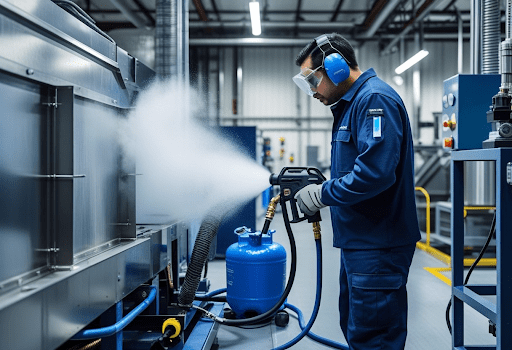
Dry ice blasting is an industrial cleaning method that uses solid carbon dioxide (CO₂) pellets propelled by compressed air to remove contaminants from surfaces. The process directs dry ice pellets through a pressurized air stream and accelerates them toward the target area using a specialized blasting system. Upon impact, the pellets interact with surface residues such as grease, oils, coatings, or production buildup. Unlike abrasive or water-based methods, dry ice blasting does not introduce additional moisture or media residue. The dry ice sublimates—changing directly from solid to gas—upon contact, which helps reduce secondary waste and simplifies post-cleaning cleanup in many industrial environments.
Kinetic Impact
Dry ice pellets are accelerated through compressed air and strike the surface at high velocity. This impact energy helps loosen and dislodge contaminants from the substrate without the use of abrasive grit.
Thermal Shock
Dry ice is extremely cold, and when it contacts warmer surface deposits, the rapid temperature difference can cause contaminants to contract and become brittle. This temperature change can weaken the bond between the residue and the underlying surface.
Sublimation Expansion
When dry ice pellets convert from solid to gas upon impact, they rapidly expand. This expansion assists in lifting and separating contaminants from the surface, contributing to the cleaning effect.
A dry ice blasting system consists of several key components working together to deliver consistent cleaning performance. An external air compressor supplies the compressed air required to propel the dry ice pellets at controlled pressure levels. The dry ice hopper stores the pellets prior to use, helping maintain a steady supply during operation. A metering system regulates the flow rate of pellets into the air stream, allowing operators to adjust output based on the cleaning application. Finally, a hose and nozzle assembly directs the pressurized mixture of air and pellets toward the target surface, enabling precise control during industrial cleaning tasks.
Nu-Ice Dry Ice Blasting is a U.S.-based manufacturer of industrial dry ice blasting systems. Founded in 1994, the company designs and builds its equipment in the United States, serving a range of industries that require non-abrasive cleaning solutions. Nu-Ice focuses on the engineering and production of dry ice blasting machines intended for industrial maintenance, surface preparation, and production cleaning environments. Its product line includes systems such as the Commando® 55™, developed for industrial applications that require controlled delivery of dry ice pellets through compressed air. When evaluating overall dry ice blasting cost, organizations often consider not only operational variables but also factors related to dry ice blasting equipment cost, including system configuration, air supply integration, and long-term maintenance requirements.
Nu-Ice dry ice blasting systems are designed with integrated components that support consistent operation in industrial settings. The blasting gun is engineered to deliver dry ice pellets through a controlled air stream, and interchangeable nozzle options allow operators to adjust the blasting pattern and focus depending on the cleaning application. These nozzles can influence pellet acceleration and coverage area during use.
Nu-Ice systems also incorporate an integrated moisture separator and aftercooler. The moisture separator helps reduce water content in the compressed air supply, while the aftercooler assists in lowering air temperature before it enters the blasting system. Together, these components help manage air quality and support stable delivery of dry ice pellets during operation in various industrial environments.
Nu-Ice dry ice blasting systems are built with industrial-grade dimensions and configurations intended for facility use. Equipment specifications include defined machine dimensions and weight to support portability within plant environments while maintaining structural durability. Hopper capacity determines how much dry ice can be loaded at one time, influencing operational duration between refills.
Air flow requirements are specified within a defined range to ensure proper pellet acceleration, and pressure ranges are outlined to match compatible compressed air systems. Dry ice consumption rates vary depending on the selected air settings and application needs. These technical specifications allow facilities to align system requirements with available infrastructure, including compressor capacity and production cleaning demands.
Preparation and Setup
Operation begins with connecting the system to a compatible compressed air supply and loading dry ice pellets into the hopper. Air pressure and pellet feed settings are adjusted according to the intended application. Hoses and nozzles are secured, and airflow components such as the moisture separator are checked prior to activation.
Safety Requirements
Operators follow standard industrial safety practices, including the use of appropriate personal protective equipment (PPE). Adequate ventilation is maintained to manage carbon dioxide gas produced during sublimation. Equipment inspections are typically conducted before use.
Typical Workflow Steps
Once activated, compressed air propels dry ice pellets through the hose and nozzle assembly. The operator directs the blasting stream across the targeted surface in controlled passes. Adjustments to air pressure or pellet feed may be made during operation as required.
Nu-Ice dry ice blasting equipment is used across a range of industrial and commercial environments. In manufacturing and production facilities, systems are applied to clean machinery, tooling, molds, and production lines where residue buildup occurs during routine operations. The process can be performed in-place in certain settings, depending on facility protocols.
In food processing environments, dry ice blasting equipment is used in sanitation and maintenance procedures where dry cleaning methods are required. Because the process does not introduce water, it can be incorporated into cleaning programs for specific equipment types under established operational guidelines.
Dry ice blasting is also utilized in historical restoration and on delicate surfaces where controlled, non-abrasive interaction is necessary. Additional applications include automotive and aerospace maintenance, electrical equipment cleaning, and other specialty industrial cleaning tasks where compressed air-driven systems are appropriate.
Dry ice blasting is characterized by the absence of secondary blasting media, as dry ice pellets sublimate into carbon dioxide gas upon impact. This reduces the need to collect and dispose of additional cleaning residue beyond the removed contaminants. The process is considered non-abrasive when properly configured, as it does not rely on grit or hard media to mechanically erode surfaces. It is also a dry and chemical-free cleaning method, which can influence handling procedures and facility integration planning. When evaluating dry ice blasting price, organizations typically review infrastructure compatibility, ventilation requirements, dry ice sourcing logistics, and long-term dry ice blasting equipment cost considerations as part of overall operational planning.
Nu-Ice dry ice blasting systems can be configured with various nozzle and hose options to accommodate different industrial cleaning environments. Interchangeable nozzles allow operators to modify the blasting pattern and focus, while hose assemblies are designed to deliver compressed air and dry ice pellets efficiently from the machine to the blasting gun.
System integration also involves proper air supply management, including compatible compressors and the use of integrated aftercoolers and moisture separators to regulate air temperature and moisture levels. Storage of dry ice and routine maintenance of components such as hoses, fittings, and air filtration systems are part of standard operational planning.
What is dry ice blasting?
Dry ice blasting is an industrial cleaning process that uses solid carbon dioxide (CO₂) pellets accelerated by compressed air to remove contaminants from surfaces. The pellets sublimate upon impact, transitioning directly from solid to gas without leaving secondary blasting media.
What equipment is required to operate a dry ice blasting system?
A typical setup includes the blasting machine, a compatible compressed air supply, dry ice pellets, hose and nozzle assemblies, and integrated air management components such as moisture separators and aftercoolers.
What infrastructure considerations are necessary?
Facilities must ensure adequate compressed air capacity, appropriate ventilation to manage carbon dioxide gas, and access to a reliable supply of dry ice pellets. Equipment placement and power requirements should also be evaluated during planning.
What safety considerations apply?
Operators generally follow standard industrial safety protocols, including the use of personal protective equipment (PPE). Proper ventilation is maintained to manage CO₂ accumulation, and equipment inspections are conducted before operation.
How does dry ice blasting compare to abrasive cleaning methods?
Unlike abrasive methods that use grit or hard media, dry ice blasting relies on solid CO₂ pellets propelled by compressed air. The process does not introduce secondary blasting material and does not involve added water or chemical cleaning agents.
Is dry ice blasting environmentally responsible?
Dry ice blasting uses recycled carbon dioxide and does not generate additional blasting waste beyond removed contaminants. Because the dry ice sublimates into gas, there is no secondary media to collect or dispose of after cleaning.
Can dry ice blasting be used in different industries?
Yes. Dry ice blasting systems are used in manufacturing, food processing, restoration projects, automotive maintenance, aerospace applications, and other industrial environments where compressed air-driven cleaning systems are appropriate.
As industrial facilities continue to evaluate cleaning methods that align with operational efficiency and infrastructure requirements, dry ice blasting remains a system-based solution supported by specialized equipment design and compressed air integration. Nu-Ice Dry Ice Blasting, founded in 1994, continues to manufacture its equipment in the United States, supplying industrial systems intended for manufacturing, food processing, restoration, automotive, aerospace, and related sectors. With configurable components, defined air requirements, and integrated air management features, Nu-Ice equipment is structured to operate within established industrial maintenance programs. Organizations assessing implementation typically review compatibility with existing air systems, ventilation planning, and dry ice sourcing as part of broader facility management considerations. As industry standards evolve, equipment-based cleaning systems remain a topic of ongoing operational review and technical evaluation.