


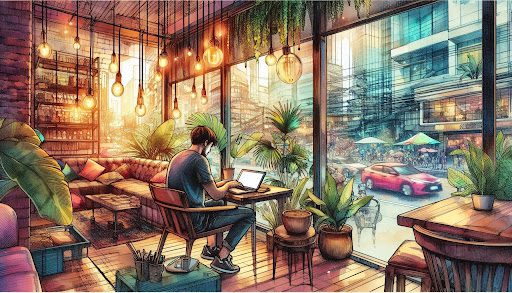
Exploring how global remote workers gain cultural literacy and autonomy while willingly sacrificing long-term community ties, career predictability, and traditional safety nets.
WASHINGTON, DC, the digital nomad movement has transformed the meaning of wealth for a generation of remote professionals who increasingly measure success through mobility, time control, cultural fluency, and the ability to build a life beyond one city, one employer, and one national routine.
The new wealth is measured in autonomy, not only income.
For many digital nomads, wealth is no longer defined only by salary, property ownership, retirement accounts, or the traditional markers of middle-class permanence that shaped earlier professional ambitions.
The new wealth is the ability to decide where morning begins, which culture shapes the week, how much life is organized around work, and whether personal identity can expand through movement rather than possession.
That shift has made remote work feel revolutionary because it separates economic productivity from geography, allowing professionals to imagine a life in which employment no longer dictates neighborhood, social class, climate, or national routine.
The trade-off is that autonomy often arrives with instability, because the worker who can live anywhere may also lose the predictability, institutional protection, and durable community ties that once came with a fixed place.
The nomadic movement is therefore not simply a travel trend, but rather a deeper reconsideration of what it means to be secure, successful, and known in a world where work increasingly travels through the cloud.
Cultural literacy has become a form of capital.
Digital nomads often gain an education that cannot be replicated through corporate training, because they learn how cities breathe, how people negotiate daily life, how governments process outsiders, and how work changes when culture is no longer invisible.
A remote worker who spends months in Mexico City, Lisbon, Bangkok, or Medellín may learn more about global behavior, informal economies, language barriers, and social adaptation than many professionals do in years spent in one office.
Cultural literacy becomes a kind of portable capital, shaping how workers communicate, build companies, understand clients, manage uncertainty, and see their own assumptions from outside the national culture that formed them.
A recent news account of digital nomads confronting the emotional limits of the lifestyle captured the central tension, showing that personal growth and loneliness can exist inside the same travel story.
The result is a generation of workers who may own less but often understand more about borders, currencies, housing markets, public systems, and the emotional intelligence required to navigate unfamiliar places.
Belonging becomes complicated when every place is temporary.
The romantic version of digital nomadism suggests that belonging can be recreated anywhere through coworking spaces, social apps, language exchanges, group dinners, and communities built around mobility itself.
That can be true for a season, but the greater difficulty is that short-term belonging often depends on people who are also preparing to leave, making friendships intense, temporary, and vulnerable to the next visa deadline.
A nomad may feel globally connected while also lacking the older forms of attachment that come from neighbors, family rituals, long friendships, local reputation, and the quiet recognition of being expected somewhere.
This creates a paradox at the center of the movement, because the same freedom that expands identity can also thin the social fabric that grounds identity.
For many remote workers, belonging becomes something repeatedly negotiated, rather than naturally inherited through a stable community where shared memory accumulates over the years.
Traditional safety nets weaken when geography becomes fluid.
The modern professional safety net was built around fixed relationships, including local doctors, nearby family, long-term employers, predictable tax systems, familiar banks, and communities that notice when something goes wrong.
Nomadic workers often trade that structure for flexibility, but the cost becomes visible during illness, job loss, family crisis, political unrest, housing instability, or sudden changes in immigration rules.
The U.S. Bureau of Labor Statistics continues to track telework as a major labor-market feature through its official telework data, yet telework itself does not solve the deeper questions around cross-border compliance, benefits, taxes, and long-term security.
A person may be able to work from anywhere, but health insurance, payroll law, pension planning, emergency care, and residence rights still operate through systems that assume people belong somewhere specific.
That mismatch explains why digital nomadism can feel liberating in ordinary weeks and frightening during a crisis, because freedom can become exposure when institutional support remains tied to places the worker has left behind.
Career predictability is another quiet sacrifice.
Digital nomads often gain time, perspective, and autonomy, but they may sacrifice the informal career advantages that come from being physically present inside professional networks, especially in companies that still reward proximity.
Remote workers can perform at a high level from anywhere, yet promotions, mentorship, political visibility, and leadership trust may still flow more easily to employees who are regularly seen by decision-makers.
That reality has grown sharper as companies distinguish among remote work from home, hybrid work within a single jurisdiction, and international work that creates tax, security, and employment complications.
The nomad who once believed geography had become irrelevant may eventually discover that career advancement still has a location, even when the work itself can be delivered through a laptop.
The most successful long-term remote professionals increasingly build deliberate systems for visibility, including scheduled headquarters visits, documented results, strong communication rituals and clear employer approval for international work.
The movement has redefined luxury as time control.
Luxury once meant bigger homes, private clubs, corporate titles, and consumer goods that signaled social arrival within one community, but many remote workers now define luxury through time, location, and personal discretion.
A month in a walkable city, a Tuesday afternoon swim, a lower-cost apartment with better weather or the ability to work near aging parents can feel more valuable than possessions tied to one address.
That redefinition does not mean money no longer matters, because mobility requires income, savings, insurance, documentation, and enough financial discipline to survive unstable housing, travel disruptions, and unexpected costs.
It means wealth is increasingly judged by optionality, with the richest worker not always the highest earner, but the person with enough control to choose place, pace, and proximity.
The digital nomad movement has made that idea mainstream, even for workers who never leave their own country, yet still want more control over where their lives unfold.
The best nomads learn that movement needs structure.
Early digital nomad culture often celebrated improvisation, suggesting that a passport, a laptop, and an adventurous mindset were enough to build a meaningful life across continents.
Experienced nomads tend to become more structured, choosing longer stays, lawful residence pathways, stable banking arrangements, tax advice, health coverage, secure housing, and fewer moves than the mythology originally advertised.
For workers considering a durable overseas base, professional planning around residency and citizenship solutions can become relevant when the goal shifts from temporary adventure to lawful international stability.
This more mature version of the movement recognizes that autonomy is strongest when it is supported by documentation, legal clarity, financial reserves, and a realistic understanding of each country’s rules.
The future of digital nomadism may therefore belong less to constant wanderers and more to globally mobile professionals who combine freedom with planning, compliance, and carefully chosen anchors.
The old home dream is being replaced by a portfolio of places.
Many remote workers no longer imagine belonging to one place forever, but they also do not want the emotional cost of belonging nowhere at all.
Instead, they build a portfolio of places, including a legal home base, a seasonal city, a family location, a professional hub, and one or two international communities where return feels familiar.
This model reflects a more sophisticated understanding of global life, where identity is not dissolved by movement but strengthened through repeated connection to places that serve different emotional and practical functions.
A worker might earn in one economy, spend part of the year in another, maintain family ties in a third, and build professional networks across several regions without fully abandoning stability.
That structure offers a middle path between traditional rootedness and total rootlessness, allowing mobility to expand life without turning every month into a new administrative challenge.
Belonging is becoming chosen rather than inherited.
The digital nomad movement has made belonging more intentional because workers who leave familiar environments must decide what kinds of people, values, rituals, and communities they want to build around themselves.
This can be profoundly liberating for people who felt confined by hometown expectations, office culture, national politics, family pressure, or the social script of permanent settlement.
At the same time, chosen belonging requires effort, because community no longer arrives automatically through school districts, long-term neighbors, religious institutions, local employers, or family networks.
Nomads must learn to create continuity through habits, recurring places, meaningful relationships, and shared obligations that survive beyond novelty.
The movement is redefining belonging by making it more portable, but the healthiest version still depends on commitment, repetition, and the willingness to invest in people without knowing how long the geography will last.
The trade-off is clearest when life becomes difficult.
The nomadic life can be exhilarating when work is stable, health is strong, flights are affordable, visas are predictable, and every new city feels like an expansion of possibility.
The same life can feel fragile when someone becomes ill, loses a contract, needs urgent legal help, faces a family emergency, or discovers that insurance does not work as expected in their current country.
Traditional safety nets may seem boring until they are needed, because familiar systems become valuable when life stops rewarding spontaneity and begins demanding reliability.
That is why some workers eventually return home, while others choose one overseas base and build deeper structures around residence, health care, banking, and community.
The lesson is not that nomadism fails, but that every freedom has a shadow, and the shadow of mobility is the need to rebuild support before crisis arrives.
Remote workers are also reshaping national competition.
Countries now compete for mobile professionals through digital nomad visas, tax incentives, technology hubs, and lifestyle branding designed to attract workers whose income comes from abroad.
This creates opportunities for local economies, but it can also produce housing pressure, cultural friction, and resentment when foreign incomes distort neighborhoods that were not built for mobile global earners.
Nomads increasingly face ethical questions about how they enter communities, whether they learn local norms, whether they contribute beyond consumption, and whether their presence benefits or displaces the people already there.
The mature version of the movement requires more than personal freedom because it asks globally mobile workers to consider the social consequences of bringing outside income into local markets.
Cultural literacy becomes meaningful only when it includes humility, respect and the recognition that a destination is someone else’s permanent home.
Privacy and mobility now overlap with security.
Some remote workers seek mobility for adventure, but others seek it for safety, discretion, political uncertainty, family security, or the ability to reduce exposure in unstable environments.
For workers who need privacy while remaining compliant, professional anonymous living planning can sit within a lawful framework when the goal is personal security, structured residence, and reduced public exposure rather than evasion.
That distinction matters because privacy is legitimate when it protects people without defeating tax, immigration, banking, or legal obligations.
The digital nomad movement has matured enough to recognize that mobility can be lifestyle, risk management, family planning, tax complexity, immigration strategy, and personal reinvention at the same time.
The challenge is building that mobility honestly, so the worker gains discretion and flexibility without creating legal problems that undermine the very stability they were seeking.
The new nomad ideal is not escape, but design.
The earliest mythology of digital nomadism was built around escape, from offices, rent, weather, taxes, routine, and the emotional predictability of conventional life.
The newer version is more deliberate, asking how a person can design a life that includes culture, autonomy, community, legal security, health care, professional growth, and enough rootedness to remain human.
That shift is important because escape is reactive, while design is responsible, requiring workers to understand what they are choosing and what they are losing.
The best remote lives are no longer built around endless motion, but around intentional combinations of movement and stillness that support both ambition and emotional health.
In that sense, the movement is growing, replacing the fantasy of permanent escape with the harder and more useful question of what kind of life freedom should actually build.
The bottom line is that digital nomads are redefining wealth by redefining home.
The digital nomad movement has made millions of workers reconsider whether wealth is best measured by fixed assets, social status, and career predictability, or by autonomy, cultural literacy, and control over time.
That freedom can be transformative, giving workers a wider view of the world, stronger adaptability, and the ability to design lives that were impossible under older employment models.
The cost is real, because long-term community, stable safety nets, predictable advancement, and inherited belonging often weaken when life becomes permanently mobile.
The future belongs to remote workers who understand the trade-off clearly, choosing not between paradise and responsibility, but between unstructured movement and a more disciplined form of global freedom.
For the public record, the digital nomad movement is not only changing where people work, but it is also changing what they believe wealth is, who they believe they belong to, and how much stability they are willing to trade for the horizon.